But Please, Don’t Forget to Find the Human in Your Enemy
I’ve had a few conversations recently about Ta-Nehisi Coates’s new book The Message. Coates is, of course, massively popular due to books like Between the World and Me, among others. He was a correspondent with The Atlantic and has garnered a large audience due to his writings on social and political issues, specifically on matters of racial injustice and white supremacy.
I have not read any of Coates’ books. I’ve listened to a few interviews with him and about him, and my general impression has been that he trades a little too easily in false binaries and moral certainty. I also tend to (half-heartedly and inconsistently) avoid anyone that Oprah recommends. This probably makes me a terrible person, I know, but what can I say? A sinner in need of grace, I have ever been and remain.
The Message is generating attention mainly, as far as I can tell, because Coates has turned his attention from the African American experience to the ongoing conflict between Israel and Palestine, a conflict which has obviously exploded over the last year. He took a ten-day trip to the West Bank and saw a great deal of human misery and suffering and injustice. He has emerged, it seems, with a rather predictable narrative of unambiguous oppressors and victims. At least this is what I have gleaned from the reviews I’ve read and the portions of interviews I’ve listened to.
I say “portions” because I recently stopped listening to an interview rather abruptly. He was being interviewed by Ezra Klein (a progressive Jew) and Klein asked him, entirely reasonably, how many Israelis he had talked to on his ten-day trip. The answer was zero. When pressed about why this was the case, Coates simply doubled down on the moral certainty. Some things and some people are just so obviously wrong, some situations just characterized by such clear Manichean categories of good and evil, that you don’t have to dig any deeper. Some people have views that simply aren’t worth countenancing.
I turned off the podcast at this point.
There are many things that could be said about Coates’ response to Klein in the interview. I will only point to two. First, it is inconceivable to me that in a conflict as intractable as the one that has dominated the Middle East for the better part of a century, someone as obviously intelligent as Coates couldn’t see any value in at least hearing an argument or perspective from the other side. He is obviously a morally sensitive man. His heart is rightly broken by the suffering of the Palestinian people and all that they have endured. What might have happened, I wonder, if he had spent some time listening to the stories of an Israeli parent whose teenage daughter had been raped and mutilated at a music festival? Even if it didn’t change his “position” on the issue, might it not blur a few categories? Humanize a group of people that are easy to demonize? Complexify an issue that does not and has never reduced to easy moral categories?
And speaking of complexity. I cannot help but note, again, that Coates wrote this book after spending ten days in the West Bank, travelling exclusively with left-leaning progressive folks. I’ve done similar tours. Twice, actually. I’ve spent twenty days listening to Palestinians sharing about the grinding oppression they must endure, watching as they are herded out of public buses to be interrogated by belligerent teenage soldiers with automatic weapons, standing with them for hours in cattle-chute like checkpoints just to get to work. I, too, heard almost nothing of the Israeli experience while I was there. Having been to the region, having heard tiny snippets of a few stories, having stuck my toe in the shallow end of the history of the region, having wrestled with the appalling cruelty that (all) people are capable of and of the deep religious hostilities and existential anxieties that animate the politics of the region, having spent the year since October 7 grappling with the many and varied ways in which this has blown apart assumed moral categories (or should have), I cannot even fathom having the audacity—as someone who doesn’t live there and doesn’t have to endure any of its realities—to write a book about it.
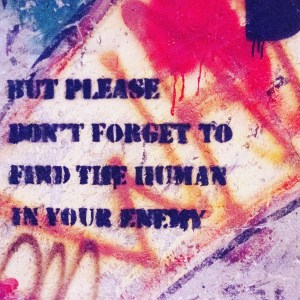
Both times I was in the West Bank, we visited the wall separating it from Israel. It’s a grotesque, imposing slab of concrete that snakes along for over seven hundred kilometres. It’s covered with graffiti of all kinds, obviously, and makes for fascinating and at times heartbreaking viewing. The last time we were there, I took the picture above. But please don’t forget to find the human in your enemy. It was obviously taken on the Palestinian side of the wall. I wonder if Coates saw it while he was there. I wonder what he made of it.
This image has served as the desktop wallpaper on my laptop ever since. I am forced to look at it whenever I am writing, whether it’s a sermon or an article or a blog post or whatever. It is a reminder that I need more often than I would care to admit. But it is one that I must not ignore if I am to do anything more than pay lip service to the One who said, “But I say to you, love your enemies and pray for those who persecute you, so that you may be children of your Father in heaven.”
Discover more from Rumblings
Subscribe to get the latest posts sent to your email.


 Rumblings
As one who has spent much of my eight years of my retirement advocating for human rights, dignity, and equality for Palestinians (energized largely by one of the very learning tours I was on, with you) and attending to the anguished cries of Palestinian church leaders asking Western Christians to stop supporting the regime that is occupying their land, robbing them of their rights, and suppressing their culture and identity, I have largely given up calling the situation a “conflict.” That term suggests a balanced power struggle between two equal “sides.” The reality here, however, is that one side has the most powerful military in the region, is backed and funded by the world’s superpower, while the other has been under occupation for 76 years, gradually losing their land and resources. This is about settler colonialism, domination, and empire–and Palestinians are the victims. None of this is to negate or excuse, however, the ghastly and brutal tactics of militants on October 7, 2023. But the background the decades of oppression, however, must be taken into account when understanding the desperation that lies behind the terrorism of those who are resisting.
I continue to think that it’s more complicated than this. We long for simplicity, for moral clarity, for unambiguous categories. But one of the things that I think we are not very good at as human beings is acknowledging that two hard things can be true at the same time.
I would say that if the actions of Hamas on October 7, 2023 need to be interpreted in the context of decades of brutal occupation (which I pointed to in the post), the actions of Israel also need to be interpreted in the context of, a) centuries of oppression and dehumanization culminating, obviously, with the Holocaust; and, b) being permanently under a kind of existential threat from the nations around them who wish them not to exist. If October 7 made anything abundantly clear, it’s that Hamas and Hezbollah are proxies of larger powers in the region (i.e., Iran) who are very committed to the region being permanently destabilized and who are prepared to sacrifice countless Palestinian lives toward that end.
I am not saying this to justify anything. I of course do not approve of the occupation just as I do not approve of the mass slaughter of innocents on October 7 (not that it really matters what I approve or disapprove of). But, again, to suggest that this conflict reduces to unambiguous good people and bad people, straightforward oppressors and victims, is to to oversimplify, in my view.
During both of my trips to Israel and the West Bank, I conducted a little thought experiment. I wondered what would happen if all the dreams of peace-loving outsiders like me were realized. What if Israel tomorrow demolished the checkpoints, abolished the punishing security restrictions, retreated from the settlements and stopped building new ones? Would there be peace? Perhaps I am guilty of looking only through the lens of a post-October 7 world. But even when I was there, well before October 7, this seemed highly unlikely to me. Prominent actors on sides (and, again, far beyond the geographic region of Israel and Palestine) have a zero-sum mentality when it comes to the land, and as long as this persists, there will be perpetual violence.
Furthernote: I also wanted to affirm your point about Christ’s call to love the enemy. Israelis and Palestinians are equal in their humanity and equally loved by God. It is the systems and powers that are evil–and when it comes to justice, we always take sides against the powers and principalities that are denying justice and dehumanizing the other.
I agree, but of course the question would then turn to context and who is laying claim to the terms “denying justice” and “dehumanizing the other.” In the West Bank and Gaza, this seems obvious enough. But many Jews would understandably point to a deep history of dehumanization (often, sadly, at the hands of Christians), not to mention the virulent strains of antisemitism that have emerged around the world post-October 7 and which were certainly latent before this. Is wishing a nation off the map dehumanizing? Are the actions of those who use Hamas and Hezbollah as their puppets “just?”
Again, I do not say any of this to justify the actions of Israel or Hamas or Hezbollah (or Iran…). The occupation remains brutal and unjust. Israel’s existential threat remains real and terrifying. Two hard things can be true at the same time. There will be no peace until and unless both sides (and those who make political decisions on their behalf) somehow come to see the human in their enemy.
Ryan, I think we agree on the main point you are making about humanizing the enemy, and my apologies for any combative tone. I don’t want to ignore the complexities, neither of history nor of the way out of the current mess. I’m reacting largely out of a context that includes the following: 1) Hearing messages from Palestinian Christian leaders, chastizing Christian denominations and organizations for “both sides-ism”–which they say only placates those who uphold a zionist outlook and obscures the deep injustices they exprience under Israeli occupation. Their clear message is: we need to take sides for justice, not make excuses for their oppression. 2) An awareness that Palestinians have been bearing the cost of western guilt over the Holocaust. Palestians were not involved in the Holocaust nor in the centuries of anti-semitism by Christendom Europe. They, both Christian and Muslim Palestinians, were living in relative harmony with Jewish communities in Palestine–until the creation of modern Israel and mass immigration by European Jews, which was enabled by European powers that were themselves steeped in colonialism and conquest. 3) Relatedly, more and more, the parallels are coming to light–or just noticed–between settler colonialism in the Americas and South Africa, and what is happening in Israel’s colonization of the Palestinian territories. Do we excuse it, or do we confront it?
In sum, it’s hard to see this as a “conflict” among equals. There is systemic injustice. Yes, you humanize the people constituting your enemy (Jewish immigrants to Israel, often fleeing other oppressive contexts; Israeli soldier conscripts brainswashed to see Paletinians as terrorists; Palestinian young men brainwashed to see Jews as evil, with limited opportunities for employment driven to hate and violence; etc.) but that is not the same as humanizing and loving the systems. Those need to change.
I have never said that the situation in Gaza or the West Bank is a “conflict among equals.” I have never attempted to justify the occupation. I have explicitly acknowledged the deep injustices that I have seen with my own eyes and heard with my own ears. I have written about this many times over the years. I have in no way claimed to love the systems that keep these injustices in place.
I am simply trying to honestly ask the question of whether or not our moral considerations ought to extend beyond the region itself and into the world where the nation of Israel clearly faces an existential threat that goes far beyond its southern and northern borders. This was the point of the thought experiment that I referred to in my previous comment (a thought experiment that I remain curious to hear your response to). If we “take a clear stance against Zionism,” whatever that might look like and however we might define the term, are we simply paving the way for ever more brutal expressions of violence in the future? Hamas and Hezbollah can hardly have been clearer about their intentions, after all, to say nothing of all those around the world for whom they speak and act. Will these intentions disappear once we “stand up against oppression?”
I am expressing a genuine moral conundrum that I and many others feel. And, again, to say that two hard things can be true at the same time is not “both-sides-ism.” I genuinely do not know what the best way forward is here. It does not seem nearly as clear to me as it does to many others (on the left or the right).
The way to see the human in your enemy is to judge on the content of character rather than on the color of skin. But progressives like Coates regard this approach as racist.
I read Between the World and Me several years ago in a book group. Other group members regarded Coates as an oracle, but I was unimpressed. When I set aside his elegant writing style, the content of what he wrote was shallow, and yet it was joined to his sense of moral superiority. Odd.
I will admit to being skeptical whenever anyone says they want to change structures and systems. Embedded in this wish is a desire to control those structures and systems. It’s a totalitarian impulse.
I have also grown skeptical of the word ‘justice’. It is a word that carries a sense of absolute certainty. If I label my view ‘justice’ then no one can disagree. Their dissent is labeled denial.
I am fine with uncertainty, ambiguity, and wide spaces for disagreement. I am a liberal, which is different than just being on the left. The two have diverged.
I very much resonate with what you say here, Christopher, particularly your first and last paragraphs. Well said.
You are wise to take my first and last paragraphs. Let my middle paragraphs go; they were written by some cranky curmudgeon of sorts. I enjoy your writing, as always. Peace.
Chris
Well, I was actually mostly nodding along to the middle two, as well. 🙂
As I’ve said, I haven’t read Coates himself, but the interviews I’ve listened to and reviews I’ve read do not impress me. I actually ended up going back and listening to the rest of his interview with Ezra Klein (a friend encouraged me to press on as it was an illuminating conversation). And she was right. But Coates just sounded fantastically naive to me, brimming with a kind of moral certainty that seemed a bit presumptuous (to put it mildly).
The idea of a two state solution seems almost grotesquely laughable in the present context. If there is anything humane and moral about the Israeli state, it needs to unilaterally implement a ceasefire.
If there is a salvageable way forward it will involve a collaborative effort between Israel, the Saudis, Egypt, Jordan and every other Arab partner in the region.
The idea of a two state solution seems almost grotesquely laughable in the present context. If there is anything humane and moral about the Israeli state, it needs to unilaterally implement a ceasefire.
If there is a salvageable way forward it will involve a collaborative effort between Israel, the Saudis, Egypt, Jordan and every other Arab partner in the region.
Hey, Ryan: Apologies for a late response; I’ve been getting ready for a solidarity visit under the Sabeel Liberation Theology Centre in Jerusalem, and probably not as attentive to the good thought you are showing here. I do acknowledge and admire your previous writing and care for peace and justice etc. The conundrums are indeed many, and like you, I don’t claim to have many answers: How to oppose Zionism while also doing justice to the legitimate fears of Jewish Israelis in a hostile environment. What a long term, sustainable future could look like that allows israelis and Palestinians to live together in safety and respect. I wish I had more time now to ponder and respond credibly. Coffee sometime would be welcome. For now, I’ll just say that I find inspiration in Jewish writers and commentators who struggle with these very questions and have moved away from Zionism, even become harsh critics of it: Peter Beinhart, Naomi Klein, Noam Chomsky, Illan Pappe, to name a few. Beinhart has also commented on Ta- Nehesi Coates and interviewed him. I’ve just heard the short video he did ahead of his interviewhttps://peterbeinart.substack.com/p/ta-nehisi-coatess-courage
Coffee some time would be great. 🙂