Could You Just Please Believe in a Soul?

I recently read a book by New York Times columnist David Brooks called How to Know a Person. It’s a good book and I commend it enthusiastically. Brooks offers a compelling diagnosis of our cultural moment and a heartfelt plea to recover the moral skills necessary to actually see and understand people, particularly in a context of deep polarization and difference.
At one point, however, he tells a story that I think perfectly encapsulates one of the deep confusions of our time. Brooks is talking about the importance of how we “show up” for each other in social contexts. He speaks of interviewing an elderly woman in Waco, TX about her life spent as a teacher in a tough neighbourhood and about the impact she had.
Brooks’ interviewing style is, in his own words, “earnest and deferential, not overly familiar, not too personal.” His posture is that of a student. And with this posture, he got one kind of response from the woman he was interviewing. She told him about her life in a detached way. She presented herself as a kind of tough but fair drill sergeant. Ordered, disciplined, committed.
Then a guy named “Pastor Jimmy” came in the room. Pastor Jimmy was teddy-bearish man in his sixties who built a church for homeless people under a highway overpass, who led a homeless shelter by his house, who served the poor. I’ll let Brooks describe how he “showed up” to the same woman:
He saw her across the room and came up to our table smiling as broadly as it is possible for a human face to smile. The he grabbed her by the shoulders and shook her way harder than you should ever shake a ninety-three-year-old. He leaned in, inches from her face, and cried in a voice that filled the whole place: “Mrs. Dorsey! Mrs. Dorsey! You’re the best! I love you!”
Brooks said he had never seen a person’s whole aspect transformed so suddenly.
The old, stern disciplinarian face she’d put on under my gaze vanished, and a joyous, delighted nine-year-old girl appeared. By projecting a different quality of attention, Jimmy called forth a different version of her.
The moral of the story, at least as Brooks tells it, is that in our world of polarization and suspicion and hostility, we need more people willing to show up for other people like Pastor Jimmy and less like, well, himself. To which I say, “yes and amen,” even as I acknowledge that I will never be the kind of person who shakes ninety-three-year-old women and yells “I love you!” at them in public places.
In the process of urging his readers to adopt more of a “Pastor Jimmy” like approaches to their neighbours and how this would transform our social fabric, Brooks says this:
When Jimmy sees a person—any person—he is seeing a creature who was made in the image of God. As he looks into each face, he is looking, at least a bit, into the face of God. When Jimmy sees a person, any person, he is also seeing a creature endowed with an immortal soul—a soul of infinite value and dignity. When Jimmy greets a person, he is also trying to live up to one of the great callings of his faith: He is trying to see them with Jesus’ eyes—eyes that lavish love on the meek and the lowly, the marginalized and those in pain, and on every living person. When Jimmy sees a person, he comes in with the belief that this person is so important that Jesus was willing to die for their sake…
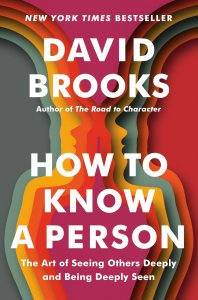
Brooks goes on:
Now, you may be an atheist, an agnostic, a Christian, a Jew, a Muslim, a Buddhist, or something else, but this posture of respect and reverence, this awareness of the infinite dignity of each person you meet is a precondition for seeing people well. You may find the whole idea of God ridiculous, but I ask you to believe in the concept of a soul…
If you consider that each person has a soul, you will be aware that each person has some transcendent spark inside them. You will be aware that at the deepest level we are all equals. We’re not equal in might, intelligence, or wealth, but we are all equal on the level of our souls. If you see the people you meet as precious souls, you’ll probably wind up treating them well.
You can probably guess what I’m going to say next. Yes, but can we actually do this? Can we just decide to believe in the concept of a soul, even if we don’t think it’s true, because it may lead to socially advantageous or desirable behaviour?
I understand why Brooks says what he says. He is writing in the context of pluralism, where people of all kinds of different tribes and tongues and creeds are trying to live peacefully in the same space. It’s natural to want to try to find common ground with those who might not share his beliefs (Brooks was raised as a secular Jew and has since become attracted to the Christian story—he describes himself as “a wandering Jew and a confused Christian”). I get this. You probably do, too.
But it seems obvious to me that this is a case where the truth of the matter matters. For David Brooks’ project to work, it matters if he is right about the value of a human being.
- Do we actually have intrinsic value or are we are just chunks of meat and bone produced by time and chance?
- Are we actually precious? All of us? Who could make such a judgment?
- Do we actually have a “transcendent spark” or is this just something we tell ourselves to make ourselves feel better?
- Do our souls actually have an immortal destiny or is our story over once we hit the dirt?
- Does Jesus’ view of the weak and the marginalized actually tell the truth of our moral obligations and God’s vision for humanity or doesn’t it?
On each one of these questions (and countless others) it matters deeply if we are right or not.
Now, of course this does not necessarily mean that if we have the right ideas about God and human beings and our reason for being on the planet then our behaviour will always wonderfully and consistently reflect this. If only!
We are not machines, where the right inputs always lead to the right outputs. We are human beings—beautiful, broken, conflicted, idealistic, inconsistent human beings. I have seen many people act in ways that were far better than what they say they believe to be true about the world. People who say they believe that there is no objective moral meaning in the world, yet who act in deeply moral ways. And of course we are all (sadly) well-acquainted with the opposite: people who claim to believe all the right things, yet do not act consistently with them.
But none of this takes away from the fact that what we believe to be right and true about the world has a deep connection to what we will at least aspire to when it comes to our behaviour. Indeed, one could argue that one of the reasons so many people feel free to speak and act so terribly toward each other these days (particularly online) is because we treat people as if they are only perspectives that we either agree with or don’t.
As the Christian story fades from our cultural consciousness, we increasingly don’t seem to believe that people have inherent worthy, dignity, beauty, that they are precious no matter what they believe. They are only the positions they hold, positions which we either find admirable or abhorrent.
To whatever extent people believe and act according to this view, I think they are wrong. And that it matters deeply, not least because of the kind of a world such beliefs create (and are creating).
The first chapter of John’s gospel contains two of my favourite words: “grace” and “truth.” Grace and truth came through Jesus Christ. How desperately we need both. “Truth” to remind us that we were created to love truth, to seek it to pursue it, to seek to live according to it. “Grace” to remind us that we are also fallen, that we are prone to errors, that we sometimes see what we want to see, that we sometimes deliberately choose falsehood over truth because the truth can be hard.
That we need to be merciful with one another because God is merciful with us.
——
Excerpted from a sermon preached January 11, 2026 at Lethbridge Mennonite Church.
Discover more from Rumblings
Subscribe to get the latest posts sent to your email.


 Rumblings
…”to whatever extent people believe and act according to this view, I think they are wrong”… I agree with you but I don’t think that matters. People are being conditioned and defined by that, “view”, wether we agree or not.
Simple truths like your last statement about mercy and a generous attitude towards everyone we meet, are our best defense. The enemy has captured our public discourse, our education system and our systems of government.
This isn’t as dire a set of circumstances as we might imagine. In fact, scripturally speaking, it is likely an inevitable outcome for all people’s at all times.
The one weapon we do have, the only weapon needed, is the one weapon the enemy can never control. The Holy Spirit of God.
Everything ends in love, justice, mercy and glory for those abide in the Spirit.
Everything else rots in hell.