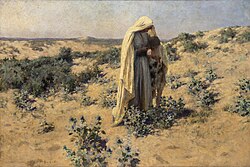
Hagar
At a church retreat last weekend, we spent some time talking about stories. Our own personal stories, the stories that we have lived into or out of, the broader stories in which we are all enmeshed. And, of course, the stories of Scripture, which for many of us have shaped us in the deepest ways, for better or for worse. It’s fascinating, as someone who is often tasked with selecting the scriptures that we will hear and reflect on each Sunday, to get a window into how people in our church look at the Bible—the stories they are drawn to, the stories that repel them, the stories that inspire them, the stories that confuse them, the stories they struggle to know what to do with or how and when to tell them.
One story from the latter category that showed up last weekend was the story of Hagar (Genesis 16, 21:8-21). Abram and Sarai are promised that a great nation would come through them but remain childless well into old age. Sarai’s solution to the problem is for her husband to have a child with their Egyptian slave-girl Hagar, but once Hagar conceives, Sarai is filled with contempt for her. Abram and Sarai callously mistreat Hagar, and she runs away to the wilderness to escape. An angel of the Lord meets her there and convinces her to return. Hagar names the Lord who spoke to her in the wilderness “El Roi.” “The God who sees.”
Time passes. Hagar gives birth to Ishmael; Sarai (who is now Sarah) eventually gives birth to Isaac. Resentments and jealousies that had gone dormant rear their ugly heads, and Hagar is banished with her son to the wilderness by Sarah. Hagar and her teenage son wander the desert until they run out of food and water. In a truly heartbreaking scene, Hagar goes and sits “the distance of a bowshot” away from her son because she can’t bear to watch him die of hunger and thirst. Again, an angel of the Lord appears, urging Hagar not to be afraid, the God who sees has seen her son and heard his cry. Her eyes are opened and she sees a well of water. The slave girl and her son are saved.
It’s a troubling story, obviously, even if it ends (reasonably) well. It can be hard to know when and how and with whom to read such a story, particularly in a world where woman and children are still so regularly banished and rendered vulnerable in all kinds of ways. The Bible is not always PG reading material, despite the impression that its most enthusiastic proponents may often give. And the story of Hagar is a hard story to read. We do well to pause on how a child might hear it, although my own view is that we tend to sell kids short in their abilities to take on hard stories. Once upon a time parents read stories like Snow White, Cinderella, and Peter and the Wolf to their children, all of which would no doubt be labelled “problematic” by today’s fairly insipid and therapeutic standards for age-appropriate stories. Somehow, we survived. But I digress.
In our last session, there was an opportunity for people to share. I think we were supposed to share about a story from the Bible that meant something to us, but it was kind of open-ended. A young woman indicated that she would like to say something. A few years ago, we sponsored her and her two children from the Congo as refugees, and she has been with us ever since. She seems impossibly young to have kids as old as hers are, and I shudder to think of what traumas might be in her rearview mirror. She has faced and continues to face significant challenges in her life, adapting to a new culture, single parenting, looking for work, etc. And even though she almost certainly comes from a more Pentecostal background, she has also become one of us, gladly offering her gifts (music, among others) to our church community.
She speaks passable English, but she wanted to speak in her heart language of Swahili. She recruited one of her kids’ friends to translate. She shared about how she came to Canada as a young woman with nothing and no one and about how, to make a longer story short, we had become her family, had given her a home, somewhere to belong. When she was done sharing, she wanted us to sing a song from our decidedly non-Pentecostal hymnal together. My daughter went to the piano and we all sang Amazing Grace. It was a profoundly moving moment, one where there were more than a few sniffles and tears around the room. I will likely never sing these lines without thinking of her story again:
“Through many dangers, toils and snares
I have already come:
’tis grace has brought me safe thus far,
and grace will lead me home.
I may also never read the story of Hagar the same again. I will likely inevitably think of the connections between these two African women. Both being “banished” from the familiar, if for different reasons and by different processes. Both finding themselves in a desperate place, fearing for themselves and for the future of their children. Both interrupted by a divine surprise while walking through a hard story. Both, in some sense, whether through an angelic visitation or the welcome of a church community, encountering El Roi—the God who sees me.
Discover more from Rumblings
Subscribe to get the latest posts sent to your email.


Faith and endurance. That He should save us from our fate or when the time comes, we should die in His arms.
A beautiful story and a beautiful telling. For me, this is you at your best. Thank you.