Desecrations
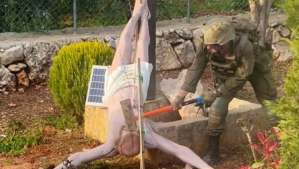
A few days ago, a story and photos surfaced about a few members of the Israeli Defense Force who took a sledgehammer to a statue of Jesus somewhere in southern Lebanon. The incident drew immediate and widespread condemnation from a wide range of ecclesial and political figures around the world.
All were keen to distance themselves from the actions of these soldiers. Words like “outrage” and “unacceptable” and “desecration” proliferated. The IDF soldiers have since been removed from duty and sentenced to thirty days in jail. The statue has been restored. The IDF will be revisiting with its members “procedures regarding conduct with religious institutions and symbols.” I gather we are all suppopsed to rest assured that everything that could be done is being done to right this wrong.
I haven’t been able to get this story out of my head this week. I’ve been thinking about that word “desecration.” According to the dictionary, to “desecrate” something is “to treat something sacred or deeply respected in a disrespectful, damaging, or offensive way.” Well, ok, I suppose pounding on an image of Jesus with a sledgehammer would qualify. One might naturally wonder if the same levels of outrage are being expressed with respect to things going on in mosques in Lebanon (and elsewhere). I suspect not. Some desecrations are more offensive (or more politically awkward) than others. Thus has it ever been.
But even beyond the selective public outrage (which we are used to by now), the irony is of course a bit rich. Religious and political leaders are “horrified” and “outraged” and “stunned” and “saddened” and demand “immediate action” when it comes to what a few soldiers do to a statue but seem fine with soldiers doing what soldiers do to other human beings. Most of the government and religious leaders in question would at least pay lip service to the idea that human beings are “sacred” and yet don’t seem to be particularly troubled that they are being treated in “disrespectful, damaging, and offensive ways” every day of every conflict in every corner of the world.
Yes, war is war. I get it. But in the commentary around this story, it sometimes seems like an inanimate statue of Jesus is getting more moral attention than those who live and breathe and bear his image.
Yesterday, I had a conversation with someone about the messy nature of Scripture. From the process of canon formation, to copying and transmission history, to the wildly disparate and oh-so-human nature of the texts and their stubborn resistance to straightforward harmonization, what are we to make of this wild collection of documents? And how are we to imagine them as authoritative and pointing to the truth about God? It was a fascinating and engaging conversation.
This week, one of the prayerbooks I use has been daily using words from Philippians 2:
Have the same mindset as Christ Jesus:
Who, being in very nature God,
did not consider equality with God something to be used to his own advantage;
rather, he made himself nothing
by taking the very nature of a servant,
being made in human likeness.
And being found in appearance as a man,
he humbled himself
by becoming obedient to death—
even death on a cross!
In Christ, the Word of God in flesh, God emptied himself of divinity. He made himself nothing. The fancy theological term for this is kenosis. The non-fancy way of saying this is perhaps to simply say that, at least in some sense, God entrusted his fate to sinful human beings. God put himself at our mercy (and we show ourselves to be decidedly unmerciful!). And perhaps, I suggested to my conversation partner, something similar is going on in the word of God written. In scripture, at least on some level, God entrusts himself to our storytelling, our understandings, our memories and copying and processes of formalization. This is God’s way in the world.
At any rate, when I looked at those pictures of the statue of Jesus being beaten with a sledgehammer, my first thought was not, “Oh my God, what a horrible desecration.” My first thought was, “Yeah, that’s kind of God’s way in the world.” God is used to being desecrated and defaced, not least by how we treat one another. God knows what it is like to be at our (lack of) mercy. God is kenotic. God makes himself nothing.
My strong suspicion is that the Risen Christ cares very little about the fate of a statue in southern Lebanon. My deep conviction is that the Risen Christ cares a great deal about the desecrations that continue around the world every day, as the sons and daughters of God are sacrificed on the altars of our wars. Not for the first time, we show ourselves to be experts at the straining of gnats and the swallowing of camels.
Discover more from Rumblings
Subscribe to get the latest posts sent to your email.


Amen! Well said Ryan. Thanks.
Just processing at this stage. Some thoughts come to mind.
Which is worse, to sin against the person of God or to sin against another human being?
Like the symbol of the snake in the desert was to Moses and the Isrealites, so to is the symbol of the cruciformed cross to us.
I cannot think of a more holy and sacred symbol than a crucified, Christ on His cross. I would think that to deliberately desecrate a cruciformed cross would be a clear sign of rebellion with and hatred of God. As clear a case of, “unforgiveable sin” as I could imagine.
How hardened and evil a heart must be to not only wage war against Christian people but after the destruction of their place of worship you are moved to take a sledgehammer to a sacred cross. Even the destruction and death you have helped create is insufficient for your hatred. You must smash the symbol of God’s salvation also. Truly an act of luciferian will. Will the heart that motivated such malevolence ever repent and seek forgiveness? I pray it is so but it it is hard to imagine.
.
It is difficult for me to muster up any real outrage (over property damage, regardless of the symbolic meaning) while the war wages on. Enjoying your blog very much, thank you.
No outrage over property damage. Just trying to come to terms with what actions like this mean for the future. Be careful not to underestimate symbolism. Symbols are powerful forces for galvanizing wills and motivating actions. Every philosophy, politic or religion insists upon them. No idea can call forth a mass response, without them.
We have always killed each other in wars over threats, real, imagined or exaggerated or more often for power and property. But when we desecrate sacred symbols as part of the warfare we could be signaling a new level depravity that we might not easily recover from. Killing because if offends God. Killing for the sake of killing. Murder and chaos for the sake of murder and chaos. Hell on earth…
One thing I am convinced of, is that our present situation on this earth goes way beyond inhumane treatment, one of the other. We are spiritually sick people’s in need of divine intervention and exorcism. The symbol of the cross can save us in a way that no philosophy, politic or ethic ever can.
To say that the destruction of a cruciform is an unforgivable act of luciferian will borders on iconolatry. If the symbol is so powerful that its destruction is ‘hell on earth,’ does that imply God’s power is fragile enough to be broken by a sledgehammer? In Christian theology, it is the human being—the Imago Dei—who is the true living icon of God. While I understand why others feel outrage for the symbol, I find my outrage is reserved for the inhumane treatment of the human beings that the symbol was meant to save.
Your last two sentences sum it up very well, Jay. Thanks.
Thanks very much, Jay. Appreciate it.
Thank you for a thoughtful and well spoken response, Jay. A good interlocutor is a treasure within every conversation
I wanted to take a little time before responding to your last comment. The subject matter is beyond heavy. There is so much that can be said, shouted, cried and screamed about the state of the world we find ourselves in. At moments like these my mind fires in several different directions and I struggle to control my emotions, stay rational and form a coherent response.
In these situations, I have learned, like I have with every important circumstance in my life, to pray first and respond later. And so it was what I did here.
Kneeling before a cruciformed cross, a conversation, a prayer happens. I speak to the King of all glory and by the power of the Holy Spirit I know that I am heard, loved, informed and forgiven. ( I would advise you or anyone else, whatever else you might say and pray for, before the Cross, that you always acknowledge your sinfulness)
I do not worship the Cross in these moments, I only worship Him who is on it. Our Lord and Savior, Jesus Christ.
The Cross is a conduit, a medium, a, “door” to be knocked on and entered through. I know, I enter through it. I will die proclaiming this truth.
As for my perspective on desecration my last thought is this. The hallmark, the very foundation of all Satanic worship is the desecration of Catholic icons and symbols and perverse interpretations of our ancient rituals. Desecration by it’s very nature is a vicious attempt to degrade God’s being and is a celebration of all that is evil.
War may be an affront to the will and word of God. Surely He does not will that we kill one another over our disagreements. On the other hand given our fallen nature, war may be an inescapable sin for mankind. Looking at human history, it would certainly seem so.
Sins of this nature, however egregious and vile, can be forgiven. Sins that desecrate and defile the Holy Spirit, again through the medium of the Cross and not the Cross itself, cannot.
We enter a deeper level of Hell when our wars with each other become open wars against God.
That’s all I have to say for now. I have some deeper and more revealing things to say about war and my part in it but I will leave that for another time. I have said enough for now.
May His peace be with you always, Jay. Thank you again, for your responses.
I appreciate your candor, but I have to be direct: I find the hierarchy of sin you’ve constructed to be deeply troubling.
You’ve characterized war—the systematic slaughter of human beings—as an ‘inescapable’ and ‘forgivable’ byproduct of a fallen nature, yet you label the destruction of a wooden symbol as a ‘Luciferian’ act that is ‘unforgivable.’ This is a massive logical and theological hole. If a human being is the Imago Dei—the only creation that actually bears the image of the Creator—then the most ‘vicious attempt to degrade God’s being’ isn’t found in a broken icon, but in a broken person.
To suggest that God is more offended by the smashing of a ‘conduit’ than the snuffing out of the life it’s meant to point toward borders on the very spiritual sickness you mention. If we reach a point where we can justify or ‘pray away’ the inevitability of war while claiming that property damage is a ‘deeper level of Hell,’ then our symbols haven’t saved us—they’ve blinded us. A God whose ‘being’ can be degraded by a sledgehammer is a fragile deity; a faith that mourns the cross more than the person on it has lost its way.
Thanks, Jay.
Perhaps the idea of transubstantiation will help you better understand me. I am talking about much more than a wooden cross. Under the principle of transubstantiation the bread and wine of the communion host retains both the natural characteristics of bread and wine and the supernatural reality of the body of Christ. In a similar way I am telling you that I personally experience the supernatural presence of Christ in the solitude of prayer, on my knees, before a cruciformed cross. Not always but often enough to believe it to be true.
In the same way that the snake bites of our Hebrew ancestors were healed before the presence of the snake/staff icon provided to them by God through, Moses. So too have the, “snake bites” of my life been healed before the presence of a Cruciformed Cross. I can only tell you what I know to be true, make of it what you will.
My point about desecration is related to but separate from my understanding and experience of the Cross. Desecration is a deliberate attack on the holiness of God. It is unforgivable because it’s proponents are agents of Satan who revel in their rebellion and hatred of God. It is unforgiveable not because of any limit to God’s mercy but because agents of Satan will never repent and seek forgiveness. They aren’t sent to hell by an angry and vengeful God rather they choose hell because of there love of Satan and all things evil.
Your suggestion that I should also see the affront God’s being when people are broken, is a compelling one and I agree wholeheartedly with it,…in the abstract but to my shame, certainly not as a lived reality.
There are so many broken people, I among them, that the burden of caring often overwhelms me and I ignore the suffering. Still further, people can be really annoying at times, me among them and it makes it easy not to care about or for them or much less see them as image bearers.
How many people have died unjustly or been brutalized as I write this, I mean really, how many?
Wtf, is all I’ve got sometimes…
Lastly, I would make a distinction between war and murder. I ascribe to an Augustinian notion of just war and the moral responsibility of soldiers to fight it, on behalf of those they would protect. Not all wars are just to be sure. Maybe none in our present circumstances but for me that all goes back to the greater sin.
Not the killing of each other, though that is often horrific and deeply sinful but rather our deliberate choice to reject God and desecrate what is holy.
If we truly want an end to war, we will follow Christ and discipline ourselves, with God’s help, to living holy lives.
Every other choice will just lead to more killing.
I can appreciate your honesty about being overwhelmed by the difficultly of contending with a broken world. We all feel that exhaustion at times. But I want to ask, if the Cross is truly the ‘door’ you say it is, why would it lead you away from the very people Christ died for? In the Gospels, Jesus’s harshest words weren’t for those who broke things; they were for those who prized religious symbols and ‘holy’ rituals while remaining indifferent to human suffering. You mention transubstantiation, but the entire point of that mystery is that the bread becomes Christ’s body so that we can become His hands and feet in a brutalized world. The symbol is a fuel for empathy, not a substitute for it.
To be honest, the thought that your perspective was some kind of prophetic revelation hadn’t crossed my mind. I find it staggering to suggest that God is ‘unforgivably’ offended by a sledgehammer hitting a cross, yet understands that a bullet hitting a human heart is just an ‘inescapable’ byproduct of war. If the voice you hear in prayer makes it easier to mourn an icon than the Imago Dei in your neighbor, I worry you aren’t hearing the Spirit, but rather an echo of your own exhaustion. It creates a bit of a religious shield to protect you from the ‘annoying’ work of actually having to care about your neighbor.
God’s holiness doesn’t need us to protect a symbol. It needs us to stop ignoring the ‘least of these.’ I hope you can see that the most ‘Luciferian’ act isn’t smashing a cross, but having a heart so hardened by religious abstraction that it can no longer muster outrage for the slaughter of God’s children.
I haven’t been led away from God’s people, Jay I’m simply acknowledging the overwhelming number of problems in our world and my complete inadequacy when it comes to solving them.
At no point have I suggested that I am indifferent to human suffering. I try to be a loving neighbor. I hope the Lord sees me as one. I think my neighbors do.
Tell me, if mustered outrage is your prescribed solution, how much does your outrage save the world?
In your last post, you were very candid about ‘ignoring the suffering’ because it’s ‘easy not to care’ about people you find ‘annoying.’ Now, you’re suggesting you’ve never been indifferent. I say this with care, but that kind of inconsistency makes it very difficult to accept your perspective as God’s word. It’s a dangerous path to claim a direct line to the Devine while your message shifts to avoid the uncomfortable parts of the Gospel.
My outrage doesn’t ‘save the world,’ but it serves as a compass. It keeps me from a theology that mourns a symbol while overlooking the very human agony you admit is hard to bear. I believe the Cross is meant to give us the strength to face that ‘annoyance’ and love people anyway—not to give us a reason to look away.
Please stop misrepresenting my position and parsing words removed from context. I told you, firstly that I wholeheartedly agreed with your position regarding suffering but simply acknowledged my insufficiency and hypocrisy in that regard. No more, no less. That’s honesty, Jay, not indifference.
I suspect all our positions shift when we are confronted with uncomfortable parts of the Gospels. It is certainly true of me. Likely true of you, also.
I don’t claim any direct line to God. I do claim that a merciful and loving God has consoled and comforted me. That I have known His presence, experienced His grace and been informed in my heart regarding certain truths. Every time this has happened, I am in a sacred space, before sacred icons. Every time.
I don’t think there is much more for us to share on this topic. We seem to be trending downhill in a shopping cart, so to speak. 😉 though I would be interested in hearing how God informs you.
His peace be with you always.
Sorry, one last point. I would caution against thinking outrage is ultimately a catalyst for love.
A shopping cart going down hill? Perhaps. Our conversation may also be akin to riding a bicycle—I certainly see lots of backpedaling. We seem to have fundamentally different perspectives on this blog/the Cross, so I agree this is probably a good spot to park it.
I’ll leave a final remark in response to your question: I am ‘informed’ by the Imago Dei—not as a concept I encounter in solitude, but as a reality I meet in the face of my neighbor. The priority of people isn’t an abstract ideal; it’s a moral baseline. I cannot justify or ignore the slaughter of God’s children by calling it ‘inescapable,’ then find property damage ‘unforgivable,’ personally.
Safe travels in that shopping cart.
Is it my failure to communicate effectively or your stubborn resistance to hearing me honestly? A bit of both, I suspect.
I don’t encounter concepts, Jay. I encounter the Holy Spirit of our Lord. You are free not to believe me but stop misrepresenting what I tell you. Do I encounter, “Imago Dei” as a reality in the face of my neighbor? Not as often as I should but I do not ignore the slaughter or the suffering of God’s children. I give of myself, my time, my energy and my money to the needs of people that God puts before me. I care and I love, very imperfectly at times but truly nonetheless.
I am just often overwhelmed by it, knowing both that my sinfulness and the fear of really giving myself over to the needs of others, contributes to the suffering and the slaughter. It is also true to my experience with addiction and the shared experience of other addicts I have known, that we are often our own worst enemies, we can deliberately and even with malice sabotage the good intentions of others and make ourselves unlikeable, unservable and wisely avoided.
And so it always leads me back to solitude, prayer and intimacy with the Lord. To sacred moments, in sacred spaces, before sacred icons. Places that help me believe that I can be raised above the profanity of life. That you can be raised above the profanity of life. That together we can help raise ourselves and others above the profanity of life.
This was never an either or dichotomy and I think in that we are all in error, in that regard.
The truth that I’m struggling to share here is that this desecration is not about property damage that our Lord would be indifferent to but rather an attack on His very person that can and will only lead to more hate, more slaughter and more of the very suffering that neither of us wants to see.
sorry should read…”not fully giving myself over to the needs of others”.
Paul, I’ve been writing in this space—incredibly!—for almost twenty years. I recently did a search on when you first left a comment and it was something like six months after I started this blog. You have been leaving comments here (with various usernames) and I have been responding to them for the better part of two decades. Many (not all) of these conversations have felt similar to the one unfolding between you and Jay.
I’m not going to comment on the post (Jay has expressed much of what I would say very well). I will simply say that if you seem to regularly find yourself in conversations that seem to be “trending downhill in a shopping cart” at some point it might be worth asking a question or two about how and why you engage in spaces like this.
Has it been 20 years, wow. Congratulations.
Fair question, Ryan but I have answered it before. Perhaps not as well as I hope to now.
Firstly I have always thought and still do think that you are an exceptional writer. That doesn’t mean I always agree with your perspectives but I think you often explain them expertly.
Point of fact, no surprise to you, I’m sure, I am most likely to engage when I disagree with you or think that your perspective is lacking in spiritual depth.
I’m not well educated from a traditional perspective. I left school at 16, for a variety of reasons, none relevant to our discussion but I think my mostly self taught learning style is as much a part of what offends you about me, than anything else.
I once read constantly, mostly classics. I have always loved the works of Feydor Dostoyevski. I then went through a modern, (at the time) phase, reading authors like Salinger, Updike then Irving and Vonnegut Jr.
Sometime after that, not sure when, but definately in that mostly deplorable decade of the 80’s, I started to see the blatant consumerism that underpinned most of literature. Given that and what I saw as the continual erosion of the Christian ethos that clearly the books I loved were a product of, I stopped trusting popular fiction and the supposed, “great authors” of that new time.
I haven’t read many novels since. I ‘ve made some effort but aside from, The Life of Pi, most books I did pick up I found to be self promoting, overly self absorbed and self pitying and or pedantic in a, “geez Louise, could you please share with us something we don’t already know” kind of way….
So I needed a new outlet for learning, viola the arrival of the internet, blogging and bitching and all the honest, bots aside, harsh/occasionally poigniant, often hilarious, (if we don’t take ourselves to seriously) latest version of the written word.
So I read several blogs and writers, engaged with some and finally settled on you. Ya poor bastard! Lol
In the end, I suppose you give me what I’m looking for and I love you for that. Thank you.
As for my, at times, curmudginly style. I’m mostly a product of my time. Men were men and sheep were nervous we used to say….you could debate, argue, strongly disagree, get angry, even punch it up a little but if you were in anyway a halfway decent guy, you could apologize later and share a drink after. I like to think of myself as a halfway decent guy. I could be wrong about that.
As for the, “shopping carts” that was my subtle way of telling, Jay he needed to stop now. He was crossing lines that weren’t good for him.
Been there, done that.
It’s interesting that you describe your ‘shopping cart’ remark as a warning for my own good while claiming to be a ‘halfway decent guy’ that doesn’t take themself to seriously. To follow a threat with ‘His peace be with you’ is spiritual gaslighting, plain and simple. Romanticizing threats doesn’t make you an old-school gentleman; it just highlights the very lack of empathy we are discussing and ‘spiritual sickness’ you previously cited.
You tell Ryan you’re here to ‘learn,’ then admit to mostly engaging when his content ‘lacks spiritual depth.’ Which is it? A student asks questions; a person who arrives already ‘informed’ by a private revelation is just looking for a podium. Your dismissal of authors, doctors, other commenters and Ryan himself suggests the latter. In case you need to hear it, le me say it is okay if you aren’t always the smartest person in the room. Surrounding yourself with those who have different expertise and deeper experiences is how we grow. Otherwise, the internet just becomes a digital echo chamber, reflecting your own biases back to you as ‘truth’ through sophisticated algorithms.
If twenty years of these conversations haven’t moved you, then ‘learning’ isn’t what’s happening here—it’s something much more dangerous and heartbreakingly sad. While I will always defend my neighbor against your ‘informed’ indifference, I am genuinely concerned for your wellness. A ‘sacred space’ that leads to a hardened heart and a 20-year cycle of conflict isn’t a place of healing; it’s a symptom of the sickness you described.
P.s. I could be your, “slim shady”….though the last time I wasted my day seeking medical advice, I was told I was borderline obese. So there’s that.
Wow, Jay….who threatened you, certainly not me. Nor did I gaslight you.
A systematic attack of another person’s point of view, especially when you misrepresenting that point of view and or reject the sincere effort of the other person to qualify their position, reflects poorly on attacker, not the person being attacked.
I wanted to stop you from losing your composure and making unkind judgement and comments. For your sake. Not mine. I’ve been around the block too many times to take offense to younger people who choose to slander the motives and character of the person they’re speaking to, rather than respectfully dialogue through a disagreement. “Sticks and stones” and all that.
I would have kept my full intentions private but when, Ryan used the term as a way of questioning why I would engage in conversations with you or implicitly himself, I made it known.
I should have also said that having your assumptions challenged and critiqued, is a far more effective way of learning then the silos of mutual congratulations and confirmation bias that pass for debate in the era of social media, we live in today.
In short, conversations of this nature run the risk of going, “off the rails” but to my mind the potential reward is worth the risk. It is also worth noting explicitly what I implicitly implied, in my last response; sometimes I’m the guy who drives the, “conversation train” off said rails.
I never claimed to be Ryan’s student. I’m not. Nor do I think I’m his teacher. Nor do I think I’m the smartest guy in the room. Often and especially when I began dialoging in this manner, I was clearly the least educated and “dumbest” guy in the conversation. But turns out I’m a big Jordan Peterson fan and I’ve always taken to heart the idea of taking on more than your capable of, in order to self improve. There have been a few regrettable bumps along the way but for the most part, that approach has paid off.
So in closing,
Paul, I have to laugh—the irony is just too good. You’ve cited Jordan Peterson as your mentor, yet you’ve managed to turn this thread into a walking case study for everything he warns against.
Peterson’s Rule 10 is to be precise in your speech. Admitting you “implicitly imply” things and “drive the train off the rails”—only to hide behind a “sense of humor that doesn’t translate” when the heat is on—isn’t being a disciple; it’s being the exact “agent of chaos” he writes books about! If you want to persuade me, start by being direct.
It is genuinely absurd to use “biblical merit” to frame the desecration of a symbol as an “unforgivable sin” while sidestepping real human suffering. Peterson talks endlessly about the sanctity of the individual and the duty to alleviate pain. Getting more worked up over a symbol than the literal agony of people is a textbook example of ideological possession. You’ve traded empathy for the safety of an abstract argument to avoid the “heavy load” of actual moral responsibility.
As for your “20-year cycle” of rejection? Rule 6 is to set your house in order before criticizing the world. If you’ve been “continually rejected” for two decades, perhaps the common denominator isn’t “younger people” or “confirmation bias.”
Peterson says to “act as if God exists” and to “assume the person you are listening to knows something you don’t.” If you actually did that, you’d look for the truth in my observations rather than playing the “slandered elder” card. This isn’t character assassination, Paul—it’s just a critique that seems to have hurt your feelings.
I’ll leave you to your time before the cross. It’s worth figuring out if you’re picking up a heavy burden that helps you grow, or just one that helps you feel like a martyr in a conflict you went out of your way to create.
…or maybe you imagine, “laughable irony” where none exists and as a consequence, your conclusions are wrong. And just maybe you should question and self reflect on the potential weaknesses of your arguments and motives, rather than spend most of your time here, reflecting on mine.
You know, speaking of irony and all…
It seems rather ironic to me that you speak in terms of your your moral compass, your clear sense of image bearing in others and the tone and tenor of how you speak to me here. You should stop and reflect on that also.
I’m not speaking from a position of, “hurt feelings”. I’ve read and reread your comments and there is a clear pattern of you, “cutting and pasting” my comments to make them support what appears to be a predetermined moral judgement on your part. In my honest opinion, a person with a real moral compass and a sense of love based on the belief that ALL others are image bearers, would show a little more empathy in their language, ask a few questions, seek clarification, and give another person whom they disagree with over the relevance of desecration (I seem to remember that was what we were supposed to be talking about lol) the benefit of the doubt.
From where I sit there is enough moral inconsistency out there for both of us.
Welcome to the person you sometimes are, and the world we live in.
So with regard to your latest post, and it’s inconsistency and sophistry, here goes.
His peace be with us always.
I can see you’re unwilling to relent from your chosen narrative and that’s quite alright; I’m ready to get back to the actual topics that brought us here too.
At the end of the day, we’re just two people in a comment section who enjoy Ryan’s writing, Peterson’s insights and a spirited conversation. With all that in common, I’m sure we’ll find ourselves on the same side of a point eventually! See ya around the neighborhood. 😀
I think I’ve been slapped and kissed, both at the same time 🙂 but yeah ok. See you around the neighborhood 🙂
I know, I stole your last word. Old men are like that.
Imaginary referee steps in to announce official score: Jay 9 – Paul 1. Tip of the hat to Ryan for the assist. This concludes your regular programming. *wink
You gave me 1! Stop flirting, Elizabeth, I’m a married man.
Reflecting on all that has been talked about here, personally I’m disappointed by what wasn’t said or shared.
This should never have been about the quality and character of my faith and always been about what constitutes desecration. What we think God’s word and our experience of God’s word through prayer, “speak” to us on the matter and where we might agree or disagree on the subject.
Whatever else I might think about the conversation to this point, I don’t think we met the faith standard we are all striving to meet.
I will agree that thre is a, “hoisted on my own petard” experience that has been valuable to me and on a personal note I am thankful but the bigger issues leading to a deeper understanding of His word hopefully leading to a deeper love, seem nowhere to be found.
So, likely tomorrow, I will reframe my perspective with the hope that it leads to a better understanding and shared exchange for us all.
Elizabeth, I would encourage you to participate but no scorekeeping until after the conversation is finished. 🙂
Hi Paul—I’m confused by your disappointment that our conversation became about your character. From my perspective, you moved the conversation in that direction when you built your argument on desecration around specific prophetic claims and personal history with addiction, education, etc.
When you use private experiences as your primary foundation for authority, you aren’t just sharing a story—you are presenting your life as the evidence. It is impossible for me to challenge your “evidence” without it feeling like a challenge to your “character,” because you have fused the two together. Given that personal anecdotes are the backbone of your stance, it’s quite difficult to have a dialogue about your point of view without my rebuttals reading like they are about you personally.
Interestingly enough, you’ve insinuated that I haven’t gotten “personal” enough regarding my own beliefs. Why would I, when:
Facts, data, and evidence shape a compelling narrative. A stranger on the internet telling me they’ve experienced the supernatural presence of Christ—and therefore they are informed on certain truths—is simply not going to change my mind.
There really isn’t much else you brought to the table to support your stance. You claimed the “foundation of all Satanic worship is the desecration of Catholic icons,” but that is a common misconception. Modern, non-theistic groups like the Satanic Temple, for instance, prioritize bodily autonomy, justice, and compassion over the “desecration” tropes found in movies. By focusing so heavily on the physical symbol, you’re missing the actual philosophy being lived out by the “image-bearers” in front of you.
To give you some context on how I approach this: I work in Learning and Development. I teach Fortune 500 executives how to use technology to better their business. On the surface, it sounds pretty easy, right? Open up the software, log in, enter password, click on a pretty little button here, load another page over there… But if you really want people to learn, not just mimic, not just recite, not just retain information, but truly understand new concepts to the point where they can think critically and ideate, you must, without question, appeal to their emotions and provide real-life experiences for them to apply your teachings. This is backed by the work of Hermann Ebbinghaus, who identified “The Forgetting Curve.” Humans are unremarkable at retention; we forget 50% of learned information within an hour, 70% within a day, and 90% of what we learn within a week if the material isn’t reinforced through an emotional or experiential lens.
So, why does this matter? I came to this discussion with a clear stance: we should prioritize living “image-bearers” over physical symbols. I backed this with Christian theology (Imago Dei). I then created an “experience” where my own lack of empathy was on display, meant illustrate exactly why it’s vital to approach neighbors with empathy rather than condemnation.
The result? You admitted this discourse has stuck with you. I haven’t moved you to agree with me (yet), but I hope this serves as a memory that encourages you to look for the Imago Dei even in those “annoying neighbors” who challenge your biases. To me, protecting the person is a much higher form of sacred work than protecting the icon.
Jay, I never “moved” the conversation and made it about my character.
I expressed an opinion based on my experience. You quickly dismissed my experience, except to use it as a means to question my character.
You now appear to be some kind of satanic sympathizer, perhaps even a satanist, yourself. I do not know. I do know that when the antichrist appears, he and his followers will use religious language and make claims that all people are image bearers. ( Jesus and the Bible make no such claim. Quite the opposite actually) and that the human person is more sacred than the God they worship.
My claim has never been that we worship an icon but rather that, motivated by sacred images, in sacred spaces , we are led to a deeper love and worship of our Lord Jesus Christ.
Jesus is your Lord and Savior, Jay. Your only Lord and Savior.
I will pray for you.
Paul, I cannot fail to note a quite breathtaking irony in some of your recent comments.
You express frustration that this conversation “should never have been about the quality and character of my faith and always been about what constitutes desecration.”
I can’t even begin to count the number of times over the last two decades where you took a post of mine and felt quite free to pontificate about the quality of my spiritual life, prayer life, priorities… the list could go on. You regularly offer unsolicited pastoral advice about stories I share here. You make almost endless assumptions about me (and others) based on the small slices of one another that we encounter online. You often leave comments that are only tangentially (at best) related to the topic of a post of mine, often steering conversations into wildly different directions to suit your own purposes. Given all this, it’s a bit rich to hear you complain in this vein.
The central claim of the post—that the actual icons of God (human beings) should matter more to us than statues—is not and should not be a controversial one, biblically, theologically, morally, rationally.
I asked Google AI, if God’s being was grounded in His holiness or in His social agency? The AI answered that, “God’s being is primarily grounded in His holiness. His absolute moral purity and, setapartness rather than His social agency. While God’s social agency is a critical expression of His nature, it is viewed as an outworking of His intrinsic, eternal holiness.”
I agree with this understanding. God is Holy. God is sacred. God is set apart. God, before all things, is to be worshipped and loved.
While this is all true, it is a very challenging concept for the material minded man to grasp, much less live out. How does a material creature convene with, love and worship his immaterial creator? Imperfectly at best.
One true way, is for the man to create, guided and sanctified by God, material objects and spaces that speak to God’s holiness and through material means help the man better understand who God is. The icon, the tabernacle, the sacrificial altar, the church are not holy in of themselves and are not to be worshipped but God makes them holy and sacred by occupying them so as to give the material minded man a material way of understanding who God is.
God had Moses fashion and icon and instructed the Isrealites to look upon it and be so doing they would be healed of poisonous snake bites. By the will and word of God an immaterial object was used as a means of transmitting God’s supernatural healing.
I do not revere the staff of Moses but I revere what God accomplished through it.
In the Gospels, there is but one example of Jesus’ wrath. He expresses it when the Jews turned, “His Father’s House”, (just a brick and mortar building to some), into a market place. He became enraged, fashioned a whip of cords and overturned tables.None of the inhumanity that Jesus witnessed and often healed, effected Him in quite the same way.
Given what sacred objects and spaces, have and can be, I think you need to rethink your, “uncontroversial, central claim”.
Well, if a bot said it, I guess that settles it. (Seriously?!)
Jesus said a few other things about temples:
– “Destroy this temple, and I will raise it again in three days” (making clear that he was the new temple)
– “I tell you that something greater than the temple is here. If you had known what these words mean, ‘I desire mercy, not sacrifice…” (making it clear that he prioritizes human beings over temple observance).
We could also look to one of this week’s lectionary readings, Acts 17:22-31.
It’s quite stunning to me that you actually seem to want to claim that Jesus was more angry about what happened in the temple than about the inhuman treatment of human beings. Aside from this just generally being a morally distasteful position unworthy of God, it sets aside the entire prophetic tradition that Jesus emerged out of which railed against injustice and the oppression of the weak, which described it as provoking God’s wrath, not to mention Jesus’ consistent anger toward the religious leaders’ prioritizing of the letter of the law over human suffering. I could go on.
So, no, I will not be rethinking the central claim of this post.
In addition to all this, you have quite conveniently sidestepped the first part of my comment above. Which is interesting.
I’m not taking the bait anymore, Ryan.
From now on I will always, “sidestep” comments like the first part of your comment. Over the years, I have apologized where I thought apology was necessary, worked diligently to improve the consistency of my communication and sincerely tried to communicate what I understand spiritually when the conversation is of a spiritual nature. I could say a lot more and have over the years but it doesn’t resonate with you. It does neither of us any good to repeat ourselves.
It is better if we leave each other to pray and self reflect about where our communication falls short of God’s mercy rather than make accusations, that often amount to half truths.
That’s all I will say for now. I need some time to pray and reflect. I will say though that I think you should make some effort, to peacefully respond to the examples of, Moses’ staff and Jesus’s cleansing of the temple.
Irrespective of your other arguments here, that I will consider, nothing you’ve said refutes the facts that God used an icon, one that Jesus said, pre-configured Himself, to supernaturally heal the Isrealites or that Jesus was enraged over the desecration of, “His Father’s House.”
1. It’s not “bait,” Paul, it’s asking you to take responsibility for your words and to be consistent. You don’t get to drop rambling essay-length bombs here all the time, change the topic whenever you feel like it, make vaguely (sometimes explicitly) insulting comments about people, assume things about people’s spiritual sensitivity when they don’t agree with you, and then when you tie yourself in knots say we should all go pray about things.
2. Nothing I (or anyone else) has said in this (tortuous) thread precludes God working through icons. To say that human beings matter more than these is not to say that they don’t matter at all.
3. There is a massive theological leap between saying that God can work and heal through physical things and saying that to destroy them is to “sin against the person of God.”
People matter to God more than physical objects. This is the quite simple point of the original post. You have now devoted many words in the (apparent) attempt to argue this point. You should ponder this more than you seem willing to do.
The Christian faith, at its heart, involves God taking on human flesh. Making himself nothing (remember this point, way back in the original post?). Allowing himself to be desecrated in order to make a way for human beings to be saved. There is so much that could be said about this, but at the very least it says a thing or two about what and how God values.
So I think it is better to understand the statement, “does not live in a house made by human hands” to mean, can not be contained by or restricted to, a house made by human hands.
After all the Father himself gave pretty specific instructions in the Old Testament as to how His temple should be constructed. Jesus explained to His parents that, if He were not with them the only other place He could be is in, ” His Father’s House” and as previously mentioned Jesus raged over the fact that His, “Father’s House” had been turned into a market place.
In this way we can still honor the encouragements regarding mercy while at the same time being careful not to contradict the words of the Father and Jesus.
As for your other quote about God not being of silver or stone. Of course I agree. That doesn’t mean however that God cannot use sacred icons in sacred spaces to communicate to and heal His people. God has (Moses’ staff) and God does.( Countless testimonies from His saints through the ages) Even to a sinner, like me.
Affirming that icons and spaces can be sacred and that to willfully destroy them is to sin against the person of God, seems to be sound a sound theological position to me.
It does not mean that I affirm the killing of innocents or am indifferent to human suffering. Or that human acts of violence can’t be steeped in sin and offensive to God.
I’m not advocating that things matter more than people, consequently there is no need for me to reflect.
This is what I’m saying;
What matters more to you, God’s holiness or people’s well being? For me it is God’s holiness. Once you embrace this idea, then all suffering, for those who believe in His holiness, is redemptive. All of it.
There are unrepentant and unforgivable sinners in the world. They do evil, for the are the children of their father, who is evil. I cannot stop them from causing great suffering.You cannot stop them from causing great suffering. The Lord asks us to endure in faith, through the suffering and in His time, He will put an end to all evil
Praise God.
God’s holiness is our well-being.
I would appreciate it very much if you would remove the picture you use to highlight your perspectives in this post. It is deeply offensive.
Paul, debating theology in the abstract is one thing, but applying your apparent worldview to real life reveals a troubling hierarchy of values.
Imagine a church is burning. You have a single moment to act: you can either save a Sunday School class of children trapped by the flames or a gold crucifix on the wall. If your worldview truly holds that suffering is ‘redemptive’ and the object is ‘sacred,’ the logical conclusion is to choose the relic while the children—who you claim find ‘spiritual treasure’ in their agony—are left behind.
Perhaps you’ll argue that this is a false choice, but in a crisis, action is the ultimate confession of faith. You cannot claim to value the ‘image of God’ while prioritizing a manufactured ‘image of sacrifice.’ To choose the gold is to commit the very sin King Hezekiah sought to end when he smashed the bronze serpent. He understood that when a holy relic becomes a distraction from the living people it was meant to point toward, it is no longer a ‘window to heaven’—it is an idol.
Furthermore, the Gospels define the ‘Temple’ not as an object, but as a Person. Jesus allowed his own physical ‘Temple’ to be desecrated on the cross specifically to end our suffering and reconcile us to God. He sacrificed the ultimate ‘Sacred’ thing to save the ‘Secular’ human life. If we refuse to do the same, we aren’t ‘protecting the sacred’; we are failing to imitate the very Christ the crucifix depicts.
This isn’t a ‘slippery slope’ toward devaluing religion. It is the Greenberg Principle: no theological statement is credible if it cannot stand in the presence of burning children. I’m sure you’ll feel compelled to comment and tell me how I’ve taken your comments out of context and that’s quite alright. As I said several messages ago, we have fundamentally different views, and the longer this conversation goes, the more I am grateful for that.
I would save the children. Not the cross. Though I would morn the loss of the cross and the church afterwards.
Arguing that sacred icons and sacred spaces matter to me and matter to God and are more than just their material substances, (which was your point and until recently, Ryan’s) does not mean that I am in anyway indifferent to human suffering.
As I wrote here, some time ago, that is a false binary. One you still seem invested in and judging me by.
I agree with the statement that icons can become idols. That is why I have been careful to say that they are sacred symbols, pathways and mediums through which God can and has both communicated and worked. In of themselves they are simply the material objects you claim them to be.
Thank you for confirming the theology you preach is a horror you’d never actually permit.
Thanks, Jay. That’s the best laugh out loud moment, I’ve had this week.
Hate to correct you – but the best laugh out loud moment in this whole thread was this one, “I know, I stole your last word. Old men are like that.” Pure gold and earned you a point.
Points are hard to come by. I’ll take them where I can get them. Thanks, Elizabeth. 🙂