On the Failures of Words
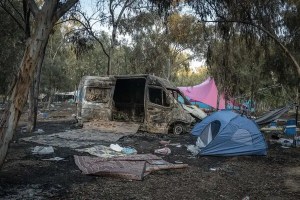
Like so many, I have spent large portions of this week marinating in media about the events that have transpired in Israel and Gaza over the last six days. What does one even say at the sight of such scenes, such images, such abject evil and depravity? Perhaps the best thing would be to say nothing. Especially those of us so far removed from things, historically and politically. What need does the world have for so many opinions incubated mostly in ignorance or even of empathy divorced from any kind of experiential connection to the land, its history, its suffering, its people? And yet, silence, too, speaks. I have written about Palestinian suffering in the past. Symmetry, if nothing else, would seem to demand a few words about Israeli suffering.
I have been to Israel and Palestine twice. I have spent time in Palestinian refugee camps. I have stood in line at early morning checkpoints with Palestinians who are herded like cattle through metal chutes. I have heard the stories of Palestinians who are treated as second-class citizens in the shadow of illegal Israeli settlements on in their own land. I have heard the stories of the victims of grossly unjust collective punishment. I have heard firsthand of the suffering of Palestinian people. I have zero doubt that the Israeli government’s policies have caused deep and protracted suffering for many innocent Palestinians and that this should not be.
But on both trips, I recall thinking (and asking), “Why aren’t we hearing any Israeli voices?” I understand (and understood) that at that time, we were prioritizing the voices of the suffering, those without power. God knows, we said to ourselves (in a weirdly self-congratulatory way), the Israelis have enough conservative religious zealots from America (and beyond) blessing and baptizing and funding their Zionism. We are deciding to listen to the voices from below. Ok, I get all that. But I also know that in any conflict it takes two to tango. There is always another side to the story. For as long as I can remember, I have been suspicious of stories with unambiguous good guys and bad guys. The world just rarely works like that. People just rarely work like that.
I have read a number of articles this week that describe the horrors we are witnessing as a moral test that the left is mostly failing. This rings true to me. I say this as someone who has lived and moved in mostly left-ish circles over the last decade or so. So many who have unambiguously cast their ideological lot with the Palestinian cause over the years have either struggled to adequately name the Hamas attacks as evil or even, more chillingly, glorified it. One can scarcely process scenes in cities like those in Sydney or Berlin or Toronto or New York where people cheer on the slaughter of civilians as “resistance” or “decolonization.” It beggars belief that in 2023 we hear people in Western nations — often those who would position themselves on the left, politically — chanting things like “Gas the Jews.”
Kat Rosenfield puts it well in my view:
This is what happens when you succumb to the Manichean worldview that every conflict, every issue, boils down to a simple question of who is the more oppressed party. Whichever guy has more privilege, more power: this is your villain. In trying to topple him from his unearned position of influence, his victim can do no wrong. Hamas, composed as it is of Muslim people of colour, is merely punching (and raping, and kidnapping) up.
One thing I did hear or read occasionally during my trips to Israel and Palestine (and afterwards) was this: the justification for Israel’s actions is that they are just a tiny nation surrounded by all kinds of nations who not only wish them harm but wish them not to exist. They are under constant threat. I don’t think I fully appreciated that until this week. It seemed theoretical. Or yesterday’s news. Perhaps even a bit of hyperbole. And then we see… well we see what we saw. We see that it is neither theoretical nor hyperbolic. One commentator I listened to this week used the image of David and Goliath. Yes, with respect to Israel and Gaza or Israel and the West Bank, Israel certainly seems like the bully Goliath and the Palestinians like little David. But in the broader context of 7 million Jews surrounded by 200 million who wish them not to exist, the roles look a bit different.
I have never been able to embrace the Manichaeism that Rosenfield speaks of above. This is not due to any virtue on my part. It is simply due to a sufficiently low view of human nature, a Christian anthropology that understands that all human beings have the capacity for good and evil. It is vanishingly rare that there exist clean categories of “oppressed” and “oppressors” that neatly behave themselves according to how we might prefer to classify them (or how it flatters us to classify them). Palestinians are not pure victims and Israelis are not pure oppressors (and vice versa). The same is true for any conflict between identity groups (because identity, in addition to power, is increasingly all that many on the left can see). Yes, power and identity matter. But they are never the whole story. Beneath these totalizing categories are moral agents and communities that have the capacity to choose, to act for good or for evil.
As I reread what I have written above, I confess to feeling dissatisfied. It expresses some of what I believe to be true about a history and a geography and a politics that is far beyond my capacity to fully understand. But I can pick apart even my own words pretty easily. Mostly, as I think about what’s going on right now, I just feel sad and angry and confused. I sift through all the articles and all the the prayers and statements coming out of official church-y channels and I find them somehow less than they could or should be. But then, so are my words. So are all words. “Words fail” is a cliché. But, well, they do.
I pray for Israel and for Palestine, for all those who suffer unimaginably due to choices not their own. I pray for peace. Four more words that fail. But what else can we do? I echo the words of Giles Fraser:
Prayer is my category for the most important of things that I cannot and do not know how to solve. Like tears, it is a bubbling up of something impossible to silence. It’s not a way of getting something done in the world; I’m not escalating stuff to the almighty. And anyway, He and I are going to have words when this is over. I have more than a few questions — and in the silence of my prayers, they won’t be gently put. But neither can I get through all of this without Him.
——
Image source.
Discover more from Rumblings
Subscribe to get the latest posts sent to your email.


 Rumblings
Hey Ryan,
Thank you so much for your reflection. I confess, I’ve seen the headlines, gotten the gist of what is going on, and for the most part, tried not to oversaturate myself with the unconscionable atrocity of it all.
When I do step into things a little bit more, horror and silence are mostly what I feel and do.
But these are waters I suppose we’ll all have to wade into at some point…
I once again appreciate your perspective. Could it be that we all write and think about these things thoughtfully, humbly, and dare I say it, meekly?
The one thing I’m stumbling on a little bit, and given the full scope of things that this is causing us all to stumble on, perhaps this is laughable… but tidy narratives are comforting, right? If I know who the good guys are, I can lock my door and sleep soundly, knowing that the bad guys are kept at bay. I can support the good guys out there and feel like a good guy myself for supporting them.
And when the narrative gets messy, as it does, it’s perhaps a little easier to cling to a simpler view of the world just to cope.
I’m a little ashamed to admit that one of my reactions has been to feel a sense of vindication that the tidy narratives being revealed for the false sense of security they bring… but then, as I’ve mulled that a little more, I’m wondering if my anthropology was low enough to account for the evils that do happen in this world in which we live, and yet, quite not low enough to allow that many people prefer to see the world in black and white because it’s just a lot easier to cope that way, even if it’s not true.
At any rate, thanks for providing a public enough space that these things can be worked out with others, but an obscure enough place that I’m not completely embarrassed by my own half-baked thoughts 😉
I resonate with much of what you say here, Kevin, particularly the “tidy narratives” part. I feel the same as you — weirdly vindicated by the collapse of certainties (on the left and the right), but… but… but… well who really cares when people are suffering and dying in unimaginable numbers? War is not (and should never be) theatre. And yet we scroll and watch and listen and read, seeking distraction? Justification? Comfort? Entertainment (God help us)? Any kind of moral or intellectual handles to grab on to in a situation that seems utterly hopeless and impossible? We want to understand, to respond in some way, to preserve our moral categories… but this conflict just seems to wash all of that away.
Kyrie eleison. What else can one say?
Kyrie eleison, indeed.
Perhaps the best/only solution starts with Jewish prayers for Palestine and Palistinian prayers for the Jews.
Thanks Ryan; appreciate the additional thoughts… words really do fail.