“Don’t Put Words in My Mouth!”
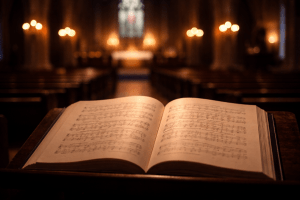
Anyone who is involved in giving leadership to corporate worship regularly finds themselves in the position of putting words in people’s mouths. Asking people to read Scripture, inviting people to participate in responsive liturgies or corporate prayers of confession, selecting songs to be sung by the gathered community—each of these elements of worship (and others) involve, on some level, some people telling other people what they should say or pray or sing out loud.
This is a risky business for a hyper-individualized age such as ours! Obviously, not every prayer or song lyric or liturgy connects with everyone in the same way. Sometimes, people may actively chafe against what they are being asked to say or sing or pray. I feel this most acutely when I lead people in corporate prayers of confession. We confess that we have sinned against you in thought, word, and deed… What a collection of words to put in other people’s mouths! Desperately necessary words, I hasten to add. But still, it can feel a bit awkward, risky, presumptuous to do so.
Lately, I’ve been thinking about the words we put in people’s mouths in the songs that we sing. Each year, during the season of Epiphany I do a sermon series based on questions asked by members of our congregation. One of the questions this year had to do with the “updating” of hymns, whether to get rid of male references to God (or at least to address the gender imbalance) or to evade theological doctrines that are deemed unpleasant (substitutionary atonement, the wrath of God, etc.) or some other thing. On any given Sunday, there are words that we sing that may grate against us for legitimate or illegitimate reasons.
It can be difficult to sort out what is appropriate critique and what is just subjective preference and nostalgia. Sometimes the words we sing are genuinely terrible and theologically incorrect. One hymn from my childhood called “Trust and Obey” always comes to mind here.
Not a doubt or a fear, not a sigh or a tear
Can abide while we trust and obey.
Seriously? Did the person who wrote these words ever read a Psalm? Or a prophet? Or the book of Job? Or any of the gospels? Or… I could barely spit those words out as a pre-teen and I certainly can’t now.
But sometimes, we just like what we like because it’s familiar, it’s what we grew up with. And nostalgia, while powerful, is not the same thing as theological accuracy or precision. In our corporate worship, we’re almost always saying and praying and singing the words of other sinners (I say “almost” because sometimes we use the words of Christ himself). To come together in corporate worship is, among other things, an act of grace. We set aside our preferences, our desires, our nostalgia and seek to “look not to your own interests but to the interests of others” (Philippians 2:4). This was, I suppose, the main point I tried to make a few Sundays ago in my sermon.
Last Sunday, I was provided with an immediate opportunity to put my own words into practice. We sang a song called “Hear the Turmoil of the Nations.” Here are a few verses:
Hear the turmoil of the nations!
How earth’s peoples sigh and groan!
Voices call for revolution;
factions thrive, and threats are thrown.
Few take time to seek God’s blessing,
which some others falsely claim.
God, whose will alone is sovereign,
soon will turn their pride to shame.Listen, all who govern nations!
Rulers of the earth, take heed!
Trust no human scheme or system
to determine how you lead.
Turn to God for strength and courage
when your fears and doubts increase;
in that longed-for place of refuge
find in God your source of peace.
It was a very appropriate song choice on a number of levels. The sermon theme of the day had to do with Christian connections to democracy and whether this political arrangement was inherently Christian (another tough faith question from my brainy congregation). The language could have come straight out of the Psalms (indeed, the writer seems to have based them on Psalm 2). And, of course, anyone who has been paying attention to the news these days (or any days) could hardly fail to find deep and fairly obvious connections between the words being put in their mouths and events of the day.
And yet. The words being put in my mouth felt awkward, forced, clunky. It was no doubt partly down to subjective preference and nostalgia. The lyrics were put to the same music of a hymn called, “O the Deep, Deep Love of Jesus,” a song I happen to love and wish was in our hymnal. And I like singing about the love of Jesus better than the turmoil of the nations, not least because I think the love of Jesus is ultimately the only source of healing for the turmoil of the nations. But could I imagine my sisters and brothers in churches in places like Tehran or Khartoum or Minneapolis finding in these words an outlet for their pain, their hopes, their fears? Could I imagine people standing with me in our own sanctuary appreciating these words for similar reasons? Could I look to their interests instead of my own? Well, yes. Obviously I could. And I should.
And I did. I sang the words that felt clunky on my tongue. I tried not to grumble too much internally about the words I’d rather be singing. I accepted that sometimes the words people put in our mouths during corporate worship may not be welcome but are often necessary and invite us into the crucial task of looking outside of ourselves.
Later that day, I put on my headphones and listened to the song I would have rather sung. Not so much as a corrective, but as a supplement. So I told myself, at any rate. 🙂
Oh, the deep, deep love of Jesus—
Vast, unmeasured, boundless, free—
Rolling as a mighty ocean
In its fullness over me!
Underneath me, all around me
Is the current of His love—
Leading onward, leading homeward
To His glorious rest above.
Discover more from Rumblings
Subscribe to get the latest posts sent to your email.


 Rumblings
The deep, deep love of Jesus that inspires trust and is reciprocated through obedience to His word. No tragedy abides where our deep and shared love of Christ exists. None.
Democracy is irrelevant to Christianity, as is every other rules based human politic. If the, “law”, whichever you abide by or find yourself living under, is your prescription for living, you are dead already. Christians live by faith and grace.