Pieces of Home
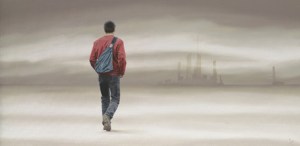
Over the past few weeks, I’ve been reading James K.A. Smith’s new book How to Inhabit Time. Smith describes the book as an “exercise in spiritual timekeeping,” learning how to recognize how our histories interact with our presents and our futures, and how God might be present and active throughout it all.
Who we are and what we may become, Smith says, is very much a product of our histories. I’m not sure he’d say it this strongly, but in many ways, we are our histories. Smith puts it quite poetically in a chapter called “A History of the Human Heart”:
Our bodies are not just clocks; they are time capsules, but time capsules that… keep emitting possibility in us. The way we experience the world—which is a singular amalgam of environment, experiences, gifts, and traumas—bequeaths to us possibilities, dispositions, desires, hopes that reside in us like spiritual muscle memories. What I aspire to is a factor of what I’ve inherited. What I imagine as a possible future—even what I can hear as a “calling”—is a reflection of what my past has made imaginable. Our now is always bequeathed to us.
We may not be able to express things quite as eloquently as Smith does in the quote above, but I think most of us intuit this on some level. Our pasts—our biology, our family history, our social location, the things we have done, the things that have been done to us—exert all kinds of influence on the people we are and will become. We are sold all kinds of pleasant illusions that to be human is to be a glorious repository of unalloyed freedom, that we can “be whatever we want to be,” but in our more honest moments we probably recognize that this isn’t exactly true. All freedom operates within constraints, and our histories are certainly among the more powerful of these.
I spend each Monday with men who desperately hope that their histories do not circumscribe the futures open to them. Some of them are terrified that they very well might. One shy, shifty young man approached me after chapel recently. He kind of half-apologized for not contributing much to discussions. “I have some mental health stuff going on.” I asked him if he’d care to share more. He glanced nervously around, before saying, “Well, I was sixteen and living with my grandparents and I came home one day to the house on fire. I tried to kick the door down, but I couldn’t get to them in time…” His voice trailed off. His eyes grew a little misty. What can one say in the face of such a history? “I’m so sorry this happened to you” feels like better than nothing and yet not nearly enough.
One of the things that often hits me on Mondays at the jail is that each one of the guys whose histories exert such awful pressure on their presents and their futures were once kids with a parent or two that at least tried to love them (or wanted to try), who had hopes for them that did not include sitting on plastic chairs in a concrete chapel. I feel this most keenly when I talk to the guys who are roughly my own kids’ age. How many parents out there, I wonder, are aching for these prodigals to come home? How many heartsick fathers and mothers are sick with worry for their wayward sons and daughters? Or are consumed by despair and regret for the ways in which they failed those entrusted to their care? Even those of us whose kids have not ended up on plastic chairs in concrete chapels find it all-too easy to worry about the futures our shared pasts have laid out for our kids.
Smith offers a word of encouragement to all the prodigals and the parents who wait at the gate, in whatever way. Homecomings are always possible, even if they will inevitably incorporate all the complexity of the history that has taken place in the intervening years:
This is why you can’t go home again: because the you that arrives is not the you that left, and the home you left is not the home to which you return. The raucous welcome-home party for the prodigal won’t immediately undo the habits formed in a distant country. But pieces of home went with the prodigal into that distant country, and it was that embedded history that served as his wake-up call to who he was, pulling him homeward.
This is the hope of every parent, I suppose. That pieces of home go with our sons and daughters. That all these histories that collide and intersect and weave together will contain enough goodness to steer each one of us to a future that is good and true and beautiful, that our failures will somehow be sloughed off and that we will collectively be lifted by the God who promises a future beyond what we can ask or imagine, a future that heals and redeems all those elements of the past that it made it seem unlikely.
A final beautiful quote from Smith. This, in some form or another, is my prayer for the guys I meet in the jail each week, for their parents, for their victims, for each one of us who accumulate things that make the road seem hard and long:
I do recall, early in my Christian pilgrimage, when a friend… pointed me to a passage in the minor prophet Joel that is perhaps familiar to many: “I will repay you for the years that the swarming locust has eaten,” the Lord promises (Joel 2:25). I still remember this as one of my first encounters with a conviction that animates this book: that the Lord of the star fields and Creator of the cosmos was attuned to the specificity and particularity of the histories we have endured in time, addressing the strange and perplexing ways we carry absence and loss in our heart and bones, the way a profound lack could exert so much power on our lives. From my earliest reading in the Gospels, I had come to understand that God knew the number of hairs on my head. But somehow it was a moving revelation to realize that God also saw what I had lived through—that the eternal God understood what I had lost, what had been missing, what the locusts had eaten and left me bereft of. In Joel’s prophetic word, I heard a promise of restoration attuned to my history—the promise of an abundant God not only making up for the lack, but wantonly overflowing the cup.
Discover more from Rumblings
Subscribe to get the latest posts sent to your email.


 Rumblings
This perspective profoundly resonates with Indigenous ways of knowing, particularly the concept of “blood memory.” Just as James K.A. Smith discusses how our histories shape our identities and futures, Indigenous cultures often emphasize the deep, ancestral connections that inform our understanding of self and community. Blood memory speaks to the idea that our bodies carry the ancestral stories, wisdom, and experiences of those who came before us. This intrinsic knowledge can influence our abilities, our worldviews, and the paths we choose to follow.
Moreover, acknowledging the weight of intergenerational trauma within Indigenous communities aligns with Smith’s reflections on how our past experiences—both positive and painful—impact our present realities. The recognition that we are not merely isolated beings with unbounded freedom, but rather interconnected individuals shaped by the legacies of our ancestors, invites us to approach our histories with both humility and gratitude. By honoring those histories, we unlock possibilities for healing and growth.
In essence, both Smith’s reflections and Indigenous teachings remind us that we are not just products of our immediate circumstances, but living embodiments of our collective pasts. This understanding invites us to embrace the complexities of our identities, recognizing that our journeys forward are deeply intertwined with the stories, struggles, and strengths of those who came before us. In this way, we not only honor our histories but also deepen our capacity to cultivate a more hopeful and intentional future.
Now on those reflections on the complexities of parenting across generations. You highlighted an important truth: the heavy-handed approaches often used by parents during challenging times, like the Great Depression, can profoundly shape their children’s experiences. Many of those children, seeking freedom from rigid rules, may have become wayward, and this rebellious spirit can continue through generations. It’s heartbreaking to consider how the lack of nurturing and warmth can prevent children from internalizing those crucial “pieces of home” that guide them toward healing and fulfillment.
As James K.A. Smith poignantly states, “the promise of an abundant God not only making up for the lack, but wantonly overflowing the cup.” This reflects the hope that, despite the pains of the past, something beautiful can emerge. Our histories and struggles don’t have to define us; we can choose a different path. Yet, I can’t help but feel that prayer alone isn’t enough. It’s through conscious choices, significant changes, and extreme effort that we begin to transform into better versions of ourselves.
In conjunction with earnest prayer and the guidance of God’s will, we can actively make a difference in the lives of those we are meant to uplift—whether that’s our own children or those who find themselves sitting in plastic chairs on concrete floors. The journey may be challenging, but with intention and perseverance, we have the potential to create a future that embodies the goodness and love we all deserve.
Well said, Elizabeth. Thanks for this.