The Flower Thief
I think it was around day ten or eleven of the Camino when we found ourselves talking to two Estonian women on a sun-baked terrazza near Pontevedra, Spain. It had been a long hot day of walking, and the patio appeared like an oasis as we emerged from a heavily treed, hilly section that seemed to go on and on. Rarely had the sound of laughing voices and clinking glasses sounded so welcome!
At any rate, the two women from Estonia didn’t need much encouragement to strike up a conversation. There were the usual preliminaries—where are you from, where did you start, when do you anticipate getting to Santiago, etc. It became quickly apparent that their schedules were rather more aggressive than ours. They were walking around 30 km/day (we were usually in the 18-24 range) and they started two days later than us. The pace was evidently taking a toll with one of the women complaining of blisters and some shoulder/neck pain. But overall, they seemed filled with joy and wonder at the experience thus far.
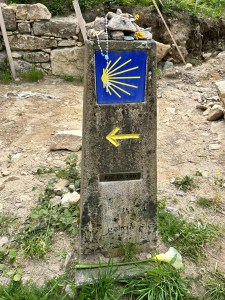
One of my travelling companions, an Anglican priest, gave them some ointments and bandages for their feet. They were as grateful for the assistance as they were incredulous that they were encountering religious professionals out in the wild (they sort of had a category for the word “priest,” but weren’t quite sure about “pastor”). They were highly inquisitive and respectful, though. They even took to calling my priest friend their “blister angel.” One of the women (her name was Elena) said that she had been picking calla lilies and leaving them at various route markers along the way—little “Elena was here” kinds of gestures. I told her I would keep my eyes open for evidence of the “flower thief.”
Two days later, at 6 am we found ourselves on a ferry with the same two women. The conversation picked up right where it left off on the terraza a few days earlier. They still seemed curiously bewildered that they were talking to a real live priest (and a pastor). How did you become one of those? Why? What’s the point? Do you get paid? Eventually, the talk turned to confession. I don’t understand the logic. So, I tell the priest my sins and he forgives me and then I just go do the same sins again? But nothing changes. My travelling companion patiently (and expertly) explained that it’s not the priest who forgives but God. He compared it to an ill-fitting or overburdened backpack. Sometimes we have to let go of some things or admit that we can’t carry them (or that we were never meant to). Confession can be like unburdening ourselves of the sins that weigh us down. Again, one of the women (her hame was Karin) had been struggling mightily with her backpack, so this metaphor seemed to connect, for obvious reasons.
As we drew nearer to our destination I said to Karin, “When we dock, my friend will have a look at your backpack. He’s an expert on how these things are supposed to fit, maybe he can adjust something to make things easier for you.” I did this without asking him, naturally. He took it all in stride. “Well, I can’t promise anything, but I can certainly have a look.” And so, he did. He tightened this strap, adjusted that one, gave a few tips on which ones to tighten first, etc. And by the time he was done, the woman could hardly believe how it felt. I thought she was going to break down in tears she was so happy. She had been carrying the weight almost exclusively on her shoulders instead of her hips. She practically bounded off like a gazelle!
Before they left, my priest friend asked if he could interview them about their reasons for walking the Camino. They obviously weren’t here for religious reasons, at least not in any traditional sense of the word. So why do this? Why walk thirty plus kilometers a day, why push through blisters and pain and heat and sore joints and all the rest of it? Their answers were eloquent and almost identical. Both spoke of how comfortable their lives in Estonia were, how they had good families, good jobs, etc., and how they had done this because they “wanted to suffer.” I couldn’t help but chuckle at this. Of course, two women from a country that until relatively recently was in the Russian orbit would talk about needing to suffer! But both spoke of wanting to challenge themselves physically, to see what was possible, and to be reminded not to take their comfortable lives for granted. Good stuff, I thought.
Elena went one step farther. She spoke about how she wanted to see a miracle. She still believed in magic, she said. She had come to walk the Camino to experience this. I had to tamp down my miserable skepticism at this point. Before I left, I had read all kinds of reflections on walking the Camino about “being part of the Camino magic,” “finding your own “inner Camino,” about “tips to bring the Camino into your everyday life once you returned,” etc. It all seemed a bit dubious, to put it mildly. It reminded me of some of the language we heard as children coming home from summer camp. I somehow doubted the first pilgrims to Santiago dragged themselves across Spain as a wellness technique. I took all of this with a rather generous grain of salt.
And yet… What if in looking for a miracle or in hoping to encounter “magic” my Estonian friend was simply expressing her longing for a world beyond the barren materialism that so many have internalized in the postmodern West? A kicking against the immanent frame that Charles Taylor describes, where there is nothing real beyond what can be apprehended by cold reason? What if she was longing for something more, something transcendent, something divine? What if, in littering the trail with ill-gotten calla lilies, the “flower thief” was expressing a desire to experience and extend a beauty that goes beyond what is rational or appropriate, to be part of something bigger and more hopeful than the nice, comfortable lives we’ve been conditioned to seek? And what if their desire to “suffer” was in some sense a longing to be absolved? A kind of secular penance for their failure to understand or acknowledge the source of the graces they enjoyed? Even the most ostensibly irreligious among us, after all, cannot help but interpret their lives through religious categories.
Before we said goodbye to our new Estonian friends, my priest friend asked if he could pray a blessing over them. They enthusiastically agreed. He spoke over us the blessing that Aaron spoke over the people of Israel, asking that the Lord would bless us, keep us, make his face to shine upon us, and give us peace.
I came across no fewer than six carefully placed calla lilies over the course of that day’s walk. Each time, I said a silent, simple prayer for ordinary miracles, for the beauty, goodness, and grace of God that refuses to remain silent, that spills out even into that for which we lack (or have forgotten) the categories.
Discover more from Rumblings
Subscribe to get the latest posts sent to your email.


 Rumblings
Wow this post resonated with me… we were booked to walk the Camino but alas COVID hit within a couple months of our scheduled leave… we have not rebooked as of yet but hope to sometime in the future… thanx for posting…
Hope you can get a chance to do it! It was a rewarding experience.