Can a Bot Long for its Maker?
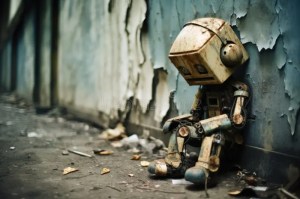
It seems that scarcely a day goes by without encountering some troubling headline about the encroachment of AI into every corner of our lives. Today’s entry was an article by a novelist named Andrea Bartz in The New York Times called “The ‘Shy Girl’ Fiasco Shows Why Trust in Writers Is Plummeting.” I knew nothing about Shy Girl, and what little I learned from the article made me long to return to my state of unknowing. Apparently, it is a horror novel that readers and journalists flagged as “having prose that sounded like AI slop.” What doesn’t, these days? At any rate, what piqued my curiosity was the bit about the plummeting of trust in writers. As one who writes for a living (essays, sermons, blog posts) I obviously have a skin in the game.
The disease is not difficult to diagnose and Bartz lays it out plainly:
But as A.I. models continue to improve, I’m concerned that it will become difficult to distinguish between something written by a human versus a bot. As more A.I.-generated writing is put out in the world, more readers will question whether the text they are poring over was penned by a human. We’re barreling toward a rapid erosion of trust between authors and readers, and the publishing industry is unprepared to deal with the consequences.
We are indeed. It grieves and angers me that this is where we are as a culture. Where we must wonder if the words we read, the things we see and hear with our own eyes and ears, can be trusted. Where our default assumption about pretty much anything we come across on a screen is, “yeah, good chance AI is responsible for some or all of that.” How can trust between readers and writers survive if we are never even sure that what we read was crafted by a human person? It can’t. And it won’t.
A few weeks ago, I attended a workshop led by a friend of mine on AI and theology. It was a fascinating and wide-ranging discussion, touching on everything from the inherently parasitic nature of AI, on how and why we so naturally (and incorrectly) attribute personhood and intentionality to bots, about the staggering energy requirements of AI and the impact this will have upon the natural world, on where and how and if AI might be good and useful (within proper constraints), and about whether any of our reflections on any of this even matters as the tidal wave of AI seems inevitable and unstoppable.
For me, the most basic and important questions about AI have to do with human personhood. How does widespread embrace of this technology form us as human persons? Does it form us in healthy ways that lead to human flourishing? Or does it deform us and subtly (or not-so-subtly) condition us to think of ourselves as machines? I think it would be extremely difficult to make the case the widespread embrace of AI is forming us in ways that make us more authentically human. On the contrary, it is probably making us lazier and more impatient, less resourceful and resilient, more manipulable, more polarized… the list could go on. And it is obviously eroding trust (see above).
Near the end of the workshop I attended, my friend asked us to consider AI through the lens of an Augustinian view of human desire. At the most basic level (and I’m undoubtedly guilty of oversimplification), St. Augustine said that a fundamental truth of the human condition is disordered desire. We desire the wrong things too much and the right things too little. And so how does AI reflect and refract our desires? In the direction of human flourishing? Or not. The answer seems—at least to me—so obvious as to barely warrant elaboration. The fact that among the major ethical issues AI companies have had to deal with in these early years is people creating and posting naked images of others speaks (profoundly unflattering) volumes.
A final note. At various points in the workshop, we were asked to wrestle with the question of what, exactly, separates a human person from a bot. If bots are so rapidly taking over all the things that human beings used to do, if they can communicate as well (or better) than we can, if they are less prone to error, if they can convey emotion and caring, if they can be made to look like human persons, where might we look for unconquered territory that is ours alone, where might be we able to stand and say, “This—this!—is irreducibly human.”
In many ways, I think the question assumes too much. Everything that a bot does is parasitic on human experience, human language, human knowledge, human expression. In no sense is a bot ever doing anything. It is simply an algorithmic response to a human prompt. We concede far too much by even referring to bots in anthropomorphic terms. But leaving that to the side, I couldn’t help but return to Augustine. Perhaps his most well-known quote comes from his Confessions:
You have made us for yourself, and our hearts are restless until they find rest in you.
In Christian theology, God created human beings in his image, and we are born with a longing for our Maker. No matter how far we stray, no matter how determined we are to deface the image of our Creator, we still retain the capacity to long for God.
We have, in a sensed, played God and created AI bots in our image. But can a bot long for its Maker? Can it long for anything? It can use the language of longing, sure. It can express the kinds of things that human persons have expressed for millennia. It can rummage around in every corner of human desire that has ever found its way on to a page or a screen.
But in this it is only ever laying claim to terrain that is properly, and irreducibly, and entirely correctly described as “human.”
—
The above was produced without the assistance of AI by a human person in around 65 minutes on a Thursday morning while listening to Mumford and Sons’ new album and drinking mediocre coffee. You can tell because it rambles a bit, probably contains a few (unintentional) mistakes, is too long and doesn’t have any bullet points.
Discover more from Rumblings
Subscribe to get the latest posts sent to your email.


I could not help but smile while reading your postscript. 🙂
Thanks for writing this very responsible article which defines AI very well. Only humans are responsible for making AI possible. Only God has created humans who are enabled by Him to respond to Him with praise and gratitude to His glory alone.
I think you miss the point. AI, from a production perspective (pick your profession) will inevitably make most of humanity redundant.
How do you think that plays out over time?
Comments with usernames (and content) like the two above (and similar email addresses) naturally make me wonder about bots leaving comments. I’ve been wondering about this for a while, given how strange some names and addresses seem.
I suppose the time will come on this blog where I have to either shut comments down or restrict it to anyone with a recognizable name and a plausible email address.
Can’t speak to the other comment but I’m a fleshie.
Not sure why the content of my question concerns you. Is there a more important question than what happens to 10’s of millions of people when they are no longer employed or even employable?
The content of some comments doesn’t “concern” me in the sense that I find it troubling; it just makes me wonder (as I said). It’s not that I know it isn’t a person, it’s just that I can’t be sure. This is kind of among the points of the article. You can never really know these days. Trust is vanishing.
I’ll also say this: I find it easier to wonder when I don’t see actual human names and instead see odd mishmashes of letters and numbers like grandpersone24cad3a2d and inquisitivelypinkcd4fcbe205.
My aim in the article was not to address production issues (which are of course massive and which should, of course, worry all of us). It was the theological anthropology at work in so many of these conversations. I don’t see how that can be missing the point.
I guess I would say that, if you asked a 1000 people what concerned them about the impending explosion of AI, within our societies,I’m betting not one of them would be concerned about the, “theological implications” AI presents.
Well, I guess I would say that 1000 people would be welcome to opine about their concerns in forums of their choosing.
Lol. Can’t say I didn’t see that one coming. Preach on, brother. 🙂
…but seriously, Ryan of course an AI bot isn’t intrinsically human. And of course from a theological perspective, bots don’t have souls but none of that matters when it comes to the survival of the human species on earth.
IF, AI has the potential it’s creator’s claim and artificial general intelligence is possible and pending, once AI systems can mimic every human aptitude and develop their own system to improve upon our knowledge, the economic and political order that we know, ceases to exists.
In every intellectual domain and in every form of physical labor AI and AI infused robots will simply be better and in time exponentially so, then the very best of us.
What value do human beings have to those who will control that technology?
Not much, probably. We have long been experts at not knowing what or how to value.
Easter is as good a time as any for the reminder that my hope is anchored what God values.
Amen.
I see hope. Or hope that I see something to hope in.
In many countries particularly in Asia and Africa, many are converting to ancient spiritual practices and customs. Mostly Roman Catholic but some Orthodox.
If a great tragedy of tyranny and extermination awaits us, our best hope is rooted in a commitment to a transcendent spirituality. Sacramental practice and rituals that depend upon the intervention of God through the Holy Spirit and our faith and belief that these practices are true interventions of the Christ, are our best chance at redemption.
Make no mistake about my intentions or my understanding. As I told you recently, half of my communal religious experience is shared with a small gathering of fellow Baptists ( about 20) here on the Rez, where I live. I am profoundly blessed to know these people and to hear the preaching of a friend and minister who shares his faith with us. That being said, a religious community, like most Protestant communities, that has only a symbolic relationship with the sacraments ( if they have any relationship with the sacraments at all) will not prevail against what is to come. The best biblical exegesis and arguments put forward by the very best and brightest, will not prevail against what is to come.
….” I tell you most solemnly, if you do not eat the flesh of the Son of Man and drink his blood you will not have life in you. Anyone who does eat my flesh and drink my blood has eternal life, and I shall raise him up on the last day. For my flesh is real food and my blood is real drink. He who eats my flesh and drinks my blood lives in me and I in him. As I, who am sent by the living Father, myself draw my life from the Father, so, whoever eats me will draw life from me. This is the bread come down from heaven; not like the bread our ancestors ate. They are dead, but anyone who eats this bread will live forever.”…
John 6: 53-59.
It will be the power of Christ and only the power of Christ, that saves us. We cannot save ourselves.
Only a belief that an ancient ritual, cited by Christ himself in scripture and inaugurated by Christ himself at the, “new passover”, the Last Supper, can save us.
Nothing else will.
clearly the inquisitively user name is yet another new name for Erahjohn. Sticks out like a sore thumb. I’ve been avoiding comments because of this reader. (And their name changes) Its hard to discern whether they have a point (more than the usual “trying to guide you to say your words more precisely”) or whether they just want to troll. Either way, I find their comments distract from the original message of your post and beg for attention with controversial viewpoints. I mean, get your own blog, buddy. Aren’t you almost 70 now? Anyways, I appreciate you Ryan for continuing to remain strong and steadfast in your purpose and calling in spite of the left shoulder demon. (If you are ever unsure if it is them – just mention U2 or Bono – they can’t help themselves but comment)
Lol, well I’m no fan of Bono, you got that much right, Elizabeth. Or of any celebrity Christian when they seem to monetize their faith and social concerns, for that matter.
My name is Paul and you are welcome to speak to me here, or not, anytime you like. Be careful about calling others a, “troll” when you talk about them but not to them, and when the substance of your criticism seems to be a judgement of their character, rather then a substantive disagreement.
As for the name changes, they aren’t intended to deceive. I got a new device, and for whatever reason my old info wouldn’t load. When I was able to access Ryan’s blog I was assigned this new name. Not sure why, I’m pretty tech illiterate.