Out of Season
I checked my phone immediately after worship on Sunday. I don’t bring my phone into the sanctuary. It stays in my study in “Do Not Disturb” mode. But my watch had been vibrating persistently during prayers of the people (evidently an exception to “Do Not Disturb” is made for multiple calls from the same number, which is wise, I suppose—emergencies and all). At any rate, I was quick to have a look once the benediction was pronounced.
Turns out, it was nothing. A friend had been pocket-dialing from a golf course somewhere. It was another notification that caught my attention. It was a note from a stranger. They had attended worship that morning at a Presbyterian Church in St. Paul, MN and wanted to thank me for my words. It seems that the preacher had used a blog post of mine from nearly a decade ago during his sermon that morning. He had even given me credit (for most of it). And a few lines of mine had made their way on to the front of the Sunday morning bulletin. All of which is kinda cool, I guess. I suppose one should be glad whenever one’s words connect.
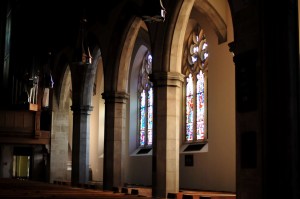
Later Sunday afternoon, my curiosity (and vanity) got the better of me and I googled the church. As luck would have it, their services are live-streamed. And so, I watched. It was a decent enough sermon. But I was struck less by the sermon and the preacher’s usage of my words than by the visual. It was a huge, ornate church. Stained glass, massive stone pillars and arches, candles, choirs, a massive organ, old-fashioned pews. The preacher wore colourful vestments and delivered his sermon from high above the congregation behind an elevated pulpit (the staff page indicated that he had approximately a hundred more degrees than I do). A quick perusal of their high-quality website indicated commitments to a broad assortment of social justice causes.
All of this was interesting, but this still wasn’t the visual that stood out. What stood out was when the camera panned out to the congregation. I imagine the sanctuary probably would have probably seated five hundred people comfortably. But, perhaps unsurprisingly, there were not five hundred people attending worship in St. Paul, MN on the 17th Sunday of Ordinary Time. It looked fairly sparse, truth be told. And fairly grey. Which is a phenomenon that many of us are growing increasingly familiar with. Yes, attendance often craters in summer as people disappear to the lakes and mountains. But still. It is always at least a little jarring to see massive houses of worship (or smaller ones) with more empty pews than full ones. It is, in many ways, a sign of the times.
In a recent piece for The Atlantic, Jake Meador articulates an anxiety that many of us feel:
Nearly everyone I grew up with in my childhood church in Lincoln, Nebraska, is no longer Christian. That’s not unusual. Forty million Americans have stopped attending church in the past 25 years. That’s something like 12 percent of the population, and it represents the largest concentrated change in church attendance in American history. As a Christian, I feel this shift acutely. My wife and I wonder whether the institutions and communities that have helped preserve us in our own faith will still exist for our four children, let alone whatever grandkids we might one day have.
I had to pause on that number. Forty million people in the past quarter century. That’s the population of Canada. I’m sure the numbers north of the border would be similar, if not higher than the 12 percent Meador cites. And I share his concern for my kids and any grandkids that might one day arrive on the scene. I suspect that we are just starting to see some of the fallout of the twenty-first century neglect, even abandonment of the church and other institutions. Meador points to rising rates of loneliness, mental illness, and alcohol and drug dependency. Yes, I see this, too. I see it everywhere. It’s not as simple as just saying that if everyone went back to church all these courses would reverse. But it surely couldn’t hurt.
He also points to how religious community generally correlates with longer life, higher financial generosity, and more stable families. This last one also made me pause. It’s not very cool to talk about “stable families” these days. It can sound very un-progressive and retrograde to talk about moms and dads raising kids, and about how healthy families should be a priority. We’re surely past the days of white picket fences and family values and stifling gender roles! It sounds a little James Dobson-y, and who wants to sound like that? Far better to acknowledge and embrace the wide range of different kinds of families that exist, and to acknowledge that families are fluid. Right?
One of the things I have been struck by in prison ministry over the past few years has been how many of the guys that I talk to on a weekly basis come from broken families. I would say north of 95 percent of them were not raised with anything resembling stability or fidelity or parents who were even remotely committed to each other or their kids. Many speak openly of never having a father figure in their life (and of desperately wanting one). They speak instead of growing up in the middle of addiction, poverty, and violence—all of which have social and systemic causes, obviously, but all of which also could be read as part of the fallout of disintegrating families, weakening institutions and crumbling social and moral norms.
The church—at least a healthy church—can help with loneliness and anxiety and depression. I believe this. How could any community devoted to the message that every human being is created and redeemed by God in love not help? I think the church can also help with producing and nurturing more stable families. It can preach and model sacrificial love, fidelity, perseverance, and commitments that go beyond the self, which is such a desperately necessary message for our moment. It might even be able to help people to be more generous and to live longer lives.
But in the end the church isn’t a self-help resource or a strategy to address weakening communities. It is an institution organized around, birthed and animated by the gospel of Jesus Christ. The news that we are sinners saved by the grace of a loving and persistent God. All those other benefits flow out of this central conviction about the human condition and what God has done about it. This message may not always be very well-received, particularly in relatively wealthy, self-sufficient circles or among people who are quite pleased with their own righteousness (i.e., most of the internet). The pews might remain more empty than full, whether in ornate stone cathedrals or humble country chapels. So be it. This is the message we are called to proclaim, in season and out.
Image above taken from the website of House of Hope Presbyterian Church in St. Paul, MN.
Discover more from Rumblings
Subscribe to get the latest posts sent to your email.


 Rumblings
The is something poignant about wealthy congregations that put up ornate stone buildings, only to have the structures empty out after a generation or two. I agree it’s a reminder of the lack of commitment to institutions. I feel grateful to have benefited from a church when I was young as well as an intact family.
On a side note. My home church showed the Focus On the Family film series when I was in high school. I remember James Dobson well! He sounded pretty sane and sensible then. It was before he got political, I guess.
I, too, find myself feeling more gratitude over time for the institutions that formed me, not least because of what I see materializing in their absence.
I actually don’t have much experience at all with Dobson. I suppose Focus on the Family just over time became a kind of emblem for a world that it was unacceptable to express anything resembling appreciation or sympathy for. I don’t doubt the organization has its sins to repent of (as do we all), but as I say in the post, the fruits of neglecting the family are becoming too many and varied to ignore.
Thank you for this, Ryan. As a young person in the Church, I’ve been thinking a lot about church decline and it weighs heavily on me every day. Grateful for your willingness to speak out about our collective need for Jesus – the only one who can save us from our sins and who has broken death forever and that the institutional church (while flawed and imperfect), is ultimately the primary (although not the only) place to experience his grace.
I also think that there’s nothing James-Dobson-y about talking about stable families and as a Christian who also happens to be a member of the LGBTQ community, I would encourage churches that tend to be seen as more “progressive” to talk about them. I, unfortunately, think that many affirming Christians and churches have shifted to solely a consent-based view of sexual ethics, which has zero scriptural support and I find that many young people my age find this view distressing and exhausting.
Thanks for your comments, Kate. I appreciate the perspective you bring. Your last sentence, in particular, is one that I think churches need to pay attention to. I couldn’t agree more with your assessment of ” a consent-based view of sexual ethics” and while the distress and exhaustion saddens me, it does not surprise me. This is far less than what we were made for.