Falling Night: Review
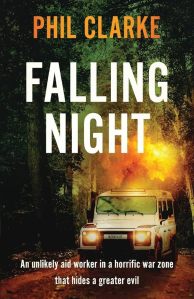
It’s been a while since I did a book review in this space. I’m not sure if I’ve ever reviewed a work of fiction. Well, no time like the present, I suppose. Philip Clarke recently published Falling Night, his first novel. Clarke spent a good chunk of the 1990s in Africa, working as first a humanitarian aid worker and then as a tropical forest researcher. He also spent nine years as executive director of Médecins Sans Frontières (Doctors Without Borders), an organization that I highly respect, and who I encountered through the writing of James Orbinski (An Imperfect Offering). Now, Clarke has moved on to fiction.
Falling Night is the story of Alan Swales, an ordinary British citizen who heads off to the fictionalized country of Kugombwala in search of adventure and heroism. He’s bored and looking for something to do that might give his life a bit of meaning (or at least impress his friends). He heads off to Africa and to do some logistical work for an organization working in international relief. He soon finds himself in the midst of both a civil war and a personal crisis of faith, asking big questions about duty, morality, and what is required of a human being thrust into a desperately inhumane context.
Clarke’s descriptions of both the horrors of war and the inner machinations of relief organizations were compelling and believable. Clarke puts the reader on the ground, as it were. It’s easy to see how the author’s own experience has informed the writing of this book. Other aspects of the narrative felt a bit forced and clunky at times. Alan’s relationship with his girlfriend Mandy, for example, felt somewhat caricatured and underdeveloped. Additionally, Alan’s religious turn, while welcome, seemed to arrive rather abruptly. Overall, though, Falling Night is an interesting and well-told story of a man whose circumstances force him to consider some of the deepest questions a human being can ask.
Again, this is clearly a deeply personal book. Clarke began writing it as an aid worker in Somalia in 1994 and it took him over twenty years to complete it. It’s not hard to imagine that having lived through experiences similar to the ones he narrates in the book, he would need some time to process, to sift through the horrors of what he had witnessed.
Two things stood out to me as I turned the last page. First, I was struck by the humanity of the characters and of international aid organizations more generally. These are real human beings not whitewashed saints. There is cynicism, there is politicking, there is an understandable world-weariness. There is doubt and fear and profound feelings of inadequacy. There are also acts of courage, hope, and inspiring faith. I appreciated this realism.
Second, there are the age-old questions that bearing witness to profound suffering and entrenched evil brings. Where is God? How can God allow this? And, perhaps most importantly (in light of the obvious fact that the first two questions do not admit of easy answers), what would God have me do? What is my responsibility? What do I owe my neighbour?
Not all of us will find ourselves in a war zone faced with appalling violence and evil. But these remain questions that every human being must wrestle with, on some level. Falling Night leads readers into questions perhaps easily ignored but no less urgent for our forgetfulness. This, I also appreciated.
I received a copy of this book from the author in exchange for my honest review.
Discover more from Rumblings
Subscribe to get the latest posts sent to your email.


 Rumblings
That sounds like the kind of book every person should read at some point in their lives!
I think I will!