On (Actual) Diversity and the Changing Face of Christianity
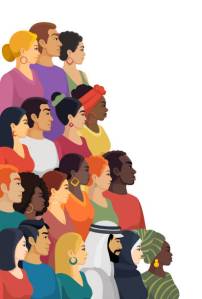
To live in the post-Christian, postmodern West is to live amidst a rather bewildering confluence of competing identities and pieties. We hear endless talk of the importance of honouring and respecting diversity in the context of pluralism, but we often seem to have no idea how to actually do this well. We’re pretty cool with diversity when it comes to race and sexuality and gender, but not so much when it comes to diversity of thought. This leads to a great deal of confusion and no small amount of incoherence in our public discourse.
The most obvious recent example of this was the unsettling story of a junior high school teacher in Edmonton hectoring (I don’t think this is too strong a word) a Muslim student for refusing to participate in Pride activities at school. It was, by most accounts, a quite ugly display. The student was told, among other things, that they “didn’t belong in Canada” if they couldn’t get on board with the school’s Pride initiatives. The incident revealed, once again, our deeply confused cultural moment. What do we do with all these identities jostling for space? Do identities related to sexuality and gender trump those associated with religion? How about race? Is this an example of Islamophobia or homophobia or transphobia or racism or plain old self-righteous ignorance? Or maybe it’s all of the above? How does one make one’s way through the thicket of all these identities and grievances and claims to victimhood?
At the very least, this story (and others like it) highlights an awkward feature of life in vaguely progressive cultures and spaces that love to talk about and claim to have very high ideals when it comes to diversity. In very general terms, the different colours of the racial mosaic tend not to seamlessly align with progressive preferences when it comes to sexuality and gender. Put bluntly, non-white minorities in historically white, Christian, western cultures tend to be more conservative and more religious than the (often) white progressives who are most eager to champion said minorities’ place in the diversity pantheon. This leads to identity collisions like the one in Edmonton.
Anyone who inhabits more progressive church spaces (as I do) will likely have noticed similar dynamics. I was recently involved in a broader church conversation about sexuality and gender. Unsurprisingly, the most progressive voices were the white ones, and the most conservative voices were the brown and black ones. Which might make us feel a bit more uncomfortable than it often seems to. Does not this phenomenon carry at least the faint whiff of something like colonialism? Are not the white voices still setting the agenda, celebrating the ethnicity of the brown and black voices while perhaps secretly tolerating their backward views on sexuality and gender (we just need to give them time to catch up with us). It’s hard not to at least occasionally think the whole thing must feel kind of paternalistic and condescending to our non-white sisters and brothers.
I’m painting with broad strokes here, obviously. It would not be hard to find examples of conservative white Christians (duh) and progressive Christians of colour. There are always exceptions to any identifiable pattern. But the pattern does seem to exist and is worth paying attention to. Tish Harrison Warren makes the point well in a recent article in The New York Times. Quoting Sam George, the director of the Global Diaspora Institute at Wheaton College:
The face of Christianity is undergoing a fundamental transformation… What is happening in America is just a part of a larger transformation because Christianity is getting a new face. It is getting more Black and brown and yellow.
As many have noted, and which I observe to be true in my own context, the mainline churches (which skew more progressive in theology and politics) are older and whiter than more conservative evangelical churches. They are also shrinking and dying. The power and the strength and the numbers of Christianity are no longer in Europe and North America, but in the much more conservative global South, the very places that Europe and North America welcomes many of its immigrants from.
This is leading to a “browning of the church” in America (and, I would argue, beyond). Which is changing the religious landscape in ways that aren’t always easy to predict or pin down. Warren describes it like this:
I quickly recognized that the standard American religious survey categories no longer account for the realities expressed in the church in America. “White evangelicalism,” “Protestant mainline” and “progressive” are categories that are largely defined by a white majority. This “browning” of the church in America, as some scholars call it, scrambles all the categories. What we are seeing isn’t simply that white evangelicalism is changing; it’s that something new is emerging.
Immigrant Christian communities are, of course, not a monolith. However, most hold convictions that overlap with traditional evangelicalism in substantial ways. They are by and large traditionally conservative about sexuality and marriage. They hold an authoritative view of the Bible and believe in miracles and supernatural occurrences.
But they tend to be more committed to social justice and, in George’s words, “communitarian” than many white evangelicals. Beyond that, it isn’t always easy to map the faith of immigrant communities using traditional Western assumptions.
What will this shifting reality mean, going forward? Well, according to Warren:
The future of American Christianity is neither white evangelicalism nor white progressivism. The future of American Christianity is probably not one where white concerns and voices dominate the conversation. The future of American Christianity now appears to be a multiethnic community that is largely led by immigrants or the children of immigrants. And that reality ought to change our present conversations about religion in America.
I think that what she says about the church in America is true throughout other parts of the West. We need to have better, more honest conversations that reflect the changing face of Christianity. The white voices need to get better at listening in ways that go beyond tokenism or treating more conservative non-white viewpoints as way-stations along the superhighway of inevitable progressivism.
We need to get better at honouring actual diversity. Whether we are conservative or progressive (or somewhere in between), white, brown or black (or somewhere in between), we need to attend to viewpoints that we don’t share with respect and a willingness to consider that others might have things to teach us. We need to stop doing the (much nicer) equivalent of what that teacher in Edmonton did, marginalizing (however kindly and tolerantly) non-white voices that don’t compliantly take their place in the racial mosaic and learn their lines when it comes to progressive politics, theology, or ethics. We need to listen.
Discover more from Rumblings
Subscribe to get the latest posts sent to your email.


 Rumblings
Wow. Amazing. Ryan, you are speaking the words that I have been speaking, but in very selective circumstances.
I welcome this change. I am embracing it. (Literally, as my husband is the son of an immigrant.) we are a multicultural family and have often wondered about where the voice of Chinese believers exists in the Mennonite context. Where does my husband’s voice matter in the midst of roll kitchen and watermelon fundraisers? Or Low German jokes shared at church potluck tables? Or the standard, “Well, that’s just the way we’ve done “it” all these years.”
Where does our voice as a family that has lived through pluralism of religion and come to the conclusion that Jesus is the answer, that He is the Way, the Truth and the Life? The “progressive” white voice of European Mennonites has come up with a comment something like this: “We’re all going to the same place anyways” or “Wow, I think I should just incorporate Buddha into my daily practices. Jesus is another great teacher, just like Buddha”. We reject this complacency because we know what it means to have an altar to Buddha and an altar to Jesus on the same platform. Spiritual confusion.
Does this make us evangelical? Or intolerant? I think it makes us relevant to people who didn’t grow up in a cultural enclave that may have had something to do with God or Jesus. To people who may, like most of the Canadian landscape, be at least three to four generations removed from any institutional experience of church, or God.
My ramblings are many, but I am thankful to you, Ryan, who open conversation up with your questions and your thoughtful comments. My God continue to bless your ministry and the Holy Spirit inspire your musings.
Thanks very much, Andrea. Your family’s perspective sounds like a very valuable one! I resonate very much with some of your questions. My wife is half-Japanese and my kids are Ojibway, so the cultural enclave has never really held much appeal for me either. As you say, asking good questions (and in good faith), seeking to hold convictions with integrity and openness in the context of pluralism—this seems to be the pressing task of our moment.
Again, thanks for your words and encouragement.
2 minorities. Support both and don’t call out 1 for not supporting the other. Fine line but Jesus can lead our efforts
Sent from Yahoo Mail on Android
Yes. He can and he must.
I’ll use this and the NYT article in a class this fall. Thanks.