Our Sense of Self
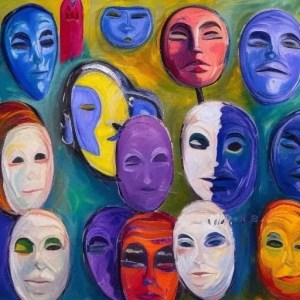
I recently received an email from someone who had concerns about various SOGI (sexual orientation and gender identity) initiatives being implemented in the school system where they worked. This person had strong convictions on the matter but expressed something bordering on helplessness when it comes to how to wade into an arena where it seems like there are landmines all around, where it seems virtually impossible to have a sane and respectful conversation that does not immediately descend into polarized tribalism and overheated rhetoric. “Well, join the club” I felt like saying.
If I were to tentatively offer a contribution into this radioactive arena of discourse, I might begin with the concept of virtue. Tolerance is certainly a virtue. So are respect for difference, kindness, compassion and justice for those on the margins. And SOGI initiatives certainly have these virtues operating at their core, at least implicitly. This is to be affirmed. Schools in pluralistic contexts like ours should indeed strive to be spaces where all are cared for and respected, where space is created for difference, where the uniqueness of each child is acknowledged, where education takes place in a context of trust and freedom from fear. This is non-negotiable in the context of pluralism in all its various forms.
But there are other virtues, as well. Virtues that schools (and families, and even churches) have largely abandoned or implicitly assumed are either retrograde or impossible to inculcate or not terribly important. Virtues like self-control, resilience, courage, gentleness. Virtues like hope and faith, mercy and forgiveness. Virtues like anything resembling a love that is able to negotiate and transcend genuine difference (not the plastic and performative versions that dominate our cultural discourse). These, too (among many others), matter. These, too, are virtues that I would want my child to be exposed to as they make their way in the world. At the very least, they would seem to warrant a place at the table where we negotiate which virtues should be taught and prioritized and why.
It seems to me—and this is based on my own experience as a parent of kids whose racial identity differs from my own, and in conversation with educators in the public system—that in our context the virtues that seem to take precedence over others are those pertaining to the self and its unencumbered identity exploration and presentation to the world. This is a problem. A culture whose main shaping institution trains its young to look at the world as a theatre for their individual identities to be negotiated and externalized and affirmed (and this, in a broader digital context that incentivizes the weaponization of identity in countless ways that are proving catastrophic to mental health, particularly among the young) is not one that will have anything capable of drawing and uniting those identities into a common narrative. We will be left with an increasingly hostile war of competing identities. Which sorta feels like the world we’re living in.
I am not naive. I doubt the culture wars are going anywhere. I doubt that we will be walking back our obsession with identity any time soon. It’s difficult to imagine anything like a robust Christian anthropology taking hold in any of our shaping institutions. But I speak and write as a Christian, and my observations of our cultural moment proceed from assumptions as Christians as I can muster. And I cannot help but be drawn, over and over again, to the central Christian themes of dying to self and living to Christ as a path to true freedom and stable identity. The promise of being loved and accepted and remade by the one who made me is so much more hopeful as an anchor than any of the accidentals of my identity, whether of race, sexuality, or gender, or religion, or anything else.
As I was thinking on these things this morning, I came across the latest of Nick Cave’s Red Hand Files. The question he was asked came from a self described “people pleaser” (I know a few of those… one happens to be writing these words!). Kellie, from Norwich, UK directed the following to Cave:
I feel like I have so much to offer as I’m very creative and I love to help people but I feel unable to move forward. I want to make so much music and art but I’m stuck still and I don’t know why. I guess I’m asking how I can find my own identity.
Cave responded eloquently and interestingly, as always. He offered a fairly exalted and demanding vision of art—one that envisions art as summoning and directing the artist rather than being an expressive vehicle for the artist themselves. As I read it, I thought Cave’s understanding of “Art” could easily be swapped out for “God.” Indeed, I did this very thing. Below is a portion of Cave’s response where I replaced the word “art” with “God.” It reads a bit awkwardly (particularly the third-from-last sentence), but I think it’s a fascinating and instructive substitution:
[God] is a divine and mysterious force that runs through all of us. It is a thing of supreme spiritual potential that only comes into its true and full being if we abandon all those cherished ideas about who we think we are or are not. [God] is entirely indifferent to our self-annihilating excuses, special case pleas and circumstantial grievances. We must cease to concern ourselves with our unique suffering—whether we are happy or sad, fortunate or unfortunate, good or bad—and give up our neurotic and debilitating journeys of self-discovery. [God] of true value requires, [like a jealous and possessive god], nothing less than our complete obedience. It insists that we retract our ego, our sense of self, the cosmetics of identity and let it do its thing. We are in service to [God], not the other way around.
A good, if perhaps inadvertent word for our cultural moment? At the very least, one worth pondering.
Image source.
Discover more from Rumblings
Subscribe to get the latest posts sent to your email.


 Rumblings
This is excellent, tight writing and clear, well-communicated thoughts on a very challenging topic. I have learned not to open your blog posts until I am prepared for the day ahead to be wondrously ruined; gloriously unsettled. They are like cold water.
Thanks very much, Louisa. This comment is, perhaps weirdly, among the most satisfying (and challenging) things that I have heard with respect to my writing in quite some time. I appreciate you taking the time to read.
Thanks Ryan. This is a provocative piece, and let me say off the top that I think I understand your concern and your charge/call, if you like, to a perhaps-lost “common narrative” of the self, or the Christian themes of dying to self and living to Christ. (And of course I don’t know the specifics of the educational environment to which the person who emailed you is referring.) I’m not, however, as alarmed by, or surprised by, “obsession with identity,” though obsession itself–about anything–is not generally considered positive. So I’d want to drop the word obsession. But I think the quest around identity as I see it playing out in the past half century or so, with the women’s liberation movement and then movements toward racial equality and now understandings of gender and so on arises from the recognition that the “common narrative” was a narrative that we accepted, or had to accept, and it was mostly masculine and mostly white and absolutely heterosexual. And this was true even under the way Christians presented dying to self and being in Christ, even though it was assumed as somehow universal and “above” human specifics. But it rarely was. And once one realizes, in whatever area, that actually the identity being spoken of doesn’t fully speak for oneself, there’s bound to be some searching and exploration, call it what you will. My example would simply be an older one–experience as a woman in the church. So, yes, it’s confusing perhaps and feels uncomfortable and perhaps a bit chaotic, but I think there’s a pretty strong case to be made for a movement of Spirit behind and within all this, and a way to be there as Christians. I think of Pentecost, when the Spirit of Jesus was exhibited as speaking in everyone’s language. A challenge for sure, but a blessing too, to find and remind about an even more basic truth about all who God has made and loves and enables to flourish.
I quite agree with Cage in terms of art. I took a wonderful week of workshop (writing short stories) with Alexander McLeod one year and the biggest takeaway was his repeated reminder that it’s the story that wants something of me, not the other way around, and demands that something to be created; it’s the story we “obey.” Nevertheless, we respond to that (art, story — even God, as per your substitution) with a “voice.” I suspect that Kellie, though using the word identity, probably meant “voice.” It’s definitely a mystery but I see the whole process as call and response.
Well this got long, and just hoping it’s not too convoluted!
Thanks, Dora. I appreciate you taking the time to read and to write in response. Not convoluted at all!
Re: the word “obsession,” you’re right, probably not a positive connotation. And yet I think that very often the shoe fits. When my young adult kids give me a glimpse into their digital world, when I look around at my peers, when I tour through the news headlines of the day, what I see is virtually everything being refracted through the lens of identity, whether it is race, sex, gender, mental health, or some other thing. All of these are increasingly being essentialized and ontologized as features of individual identity. Again, when this is combined with the felt imperative to externalize these things out into the world for approval or for combat, the results are catastrophic (for mental health, for social discourse, for political peace, etc).
You are of course right to point out that “common narratives,” whatever they are, often do great harm to those who do not fit within it. The word “harm” is increasingly a very malleable term, but to the extent that our common narratives, wherever they are and whoever controls them have prevented people from having the freedom to choose their own course, or has dehumanized or degraded them in any way, this is to be repented of. I suppose only time will tell if the common narrative that is increasingly most compelling in the West (the subjective self as the locus of ethical and political obligation) will bear the fruit of freedom, peace, mutuality, and flourishing that it claims to promise.
Thanks for sharing your experience in the writing workshop. I so admire those like yourself who can summon intricate and compelling narratives from the ground up. I can easily imagine that this must feel like responding to something outside of oneself. With respect to the Cave quote, I suppose the part that I was drawn to was the idea that the voice ought not to overwhelm or drown out the “art” (or, “God”) who calls it forth. I worry that in our time we are too often at risk of swapping out the ultimate for the penultimate.
Eloquent and well written, as usual. 😊
In college I went through the Topical Memory System, a set of 60 Bible verses to memorize. The first two are Gal 2:20 and 2 Cor 5:17, which anchor our identity in Christ, just as you advocate. Every day I am grateful to have those verses ‘hidden in my heart’ so that I know who I am.
Thank you, Chris. I could hardly imagine two more important verses to commit to memory!