Orphans
I saw a screenshot in the aftermath of the Trump assassination attempt on Sunday. Some academic somewhere saying something to the effect of, “So close!” The gleeful comments obligingly took their place below. Should have had better aim! Dammit, just an inch the other way. What a glorious day this could have been! Etc., etc. The screenshot was captured as a gotcha moment. Look at all these self-righteous “progressive” elites who claim to have the moral high ground, wallowing around in the mud of glorying in an attempted assassination. It was all so wearyingly predictable. And of course, if it had been Biden’s ear that was grazed, the same sad scenario would have been playing out in different corners of the internet that are emotionally invested in being perpetually aggrieved in other directions. We are, it has seemed to me for a very long time now, grossly and terrifyingly invested in who and how we hate.
A few weeks ago, I listened to an interview with Stanford scholar Cynthia Haven on a book she edited on the thought of Rene Girard. I’ve encountered Girard often over the years, but mostly on a very surface level. I have a basic understanding of his work on scapegoating and the mimetic nature of desire, but that’s about it. A lot of the interview kind of sailed past me, but I was struck by one part where the interviewer seemed to be genuinely struggling with Girard’s idea that until we can understand ourselves as “perpetrators” or “persecutors” we won’t really understand much about human nature. How, I wondered, could anyone struggle with this?
Haven seemed to agree. She responded, in part, thus:
Goodness. Isn’t it obvious? We’re perps. I mean, we think of ourselves as the innocents, the people that are put upon. But we don’t have to think very hard before each one of us, I mean, I don’t think it’s presumptuous for me to assume I’m speaking for everyone. Each of us has been a perpetrator of injustices on a bigger, small scale. Whether it’s punishing your kid because you’re mad at someone else at the office, or just turning away from people that need help. I mean, it goes on and on. We’re all guilty of stuff. We’re all guilty of bending the truth. We’re all guilty of rewriting the story to favor our own innocence.
It’s easy to read that paragraph and slap it on to our ugly, polarized cultural moment or the endless tawdry theatre that masquerades as politics. Both sides rewrite the story to favour their own innocence. Both sides bend the truth. Both sides airbrush the public narrative to exclude inconvenient, unflattering data. Etc., etc. This would all be very true. Maybe even useful and necessary. It’s far harder to apply it to ourselves.
But we must. We must drill down into the granular level of our lives, honestly interrogating things like the way we talk to our kids, the way we respond to our spouses at the end of a day, the ways we engage on social media, the content we consume (and the impulses in us that this feeds), the way we criticize or mock other people to justify ourselves or make ourselves look better than we are, the way we all are so very prone to rewriting the story—big stories, small stories, and every story in between—to favour our innocence. If our politics or our culture are ever to change, we must be honest about who we are. We are all perps. We are not innocent.
I’ve been pondering the story of Jesus’ healing the man born blind for a while now. It’s one of the guys in the jail’s favourite scenes from The Chosen. We’ve also read the actual story from the ninth chapter of John’s gospel. The healing is very cool, yes. But they really love it when Jesus puts the Pharisees in their place. How could those Pharisees be obsessing about days of the week and Sabbath violations when a guy just got his sight?! What is wrong with them? They love it when the guy who was healed essentially says, “Obsess about your rules all you want, all I know is that I was blind but now I can see.”
The punch line of the story is the end. The Pharisees overhear Jesus talking to the man born blind. Jesus says, “I came into this world for judgment so that those who do not see may see, and those who do see may become blind.” The Pharisees shuffle their feet and look awkwardly around. Surely, he’s not talking about us! Jesus then speaks directly and unambiguously to them. “If you were blind, you would not have sin. But now that you say, ‘We see,’ your sin remains.”
If you were blind, you would not have sin… Somehow, in the kingdom of God, there is a blindness that is a prerequisite to seeing God, the world, and our selves truly. We must recognize that we cannot see truly unless our vision is refracted through the love and the mercy of God. If we insist on seeing through the categories of our own righteousness, our own innocence, our own moral heroism, our own self-congratulatory categories of identity, or—God help us—by who we hate, then we will remain helplessly and dangerously blind. Our sin will remain.
One of the other things that Cynthia Haven mentioned near the end of the interview was the story of Herod (the Jewish puppet king) and Pilate (the Roman governor) bonding together around the crucifixion of Jesus in Luke 23). These former enemies became friends around the scapegoating of an innocent man. Of this, Haven said,
We bond by joining the persecutors. It’s hard to be an orphan.
Indeed, it is. Perhaps the time has come for the blind orphans to show the way. The ones who refuse to pile on, to stake out territory, to perform their moral and political allegiances for the world to affirm or condemn, to derive meaning and identity from who and how they hate. The ones who know (or want to know) how very little they see, who refuse (or want to refuse) to join the stone throwers, who look (or want to look) to the Lord of love alone for rescue.
——
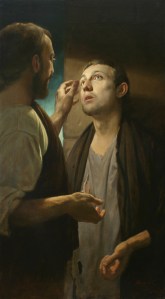
Title: Christ and the Pauper
Date: 2008
Artist: Mironov, Andreĭ
Discover more from Rumblings
Subscribe to get the latest posts sent to your email.


 Rumblings
Ryan, thank you for an eloquent frame of reference for the times we live in. Your words are poetic, prophetic and purposefully personal. With Girard in mind, Psalm 37.4 for you.
Keep equipping us to think; and think again.
Thanks, Ken. Appreciate these kind words (and the verse).
Hey Ryan! I appreciated this reflection- two things: a question and a comment.
First up is the question. I get that the moment feels particularly polarized — but I don’t know that, on the whole, we’re much worse (or much better) than humanity on a historical scale. As you note… “We are, it has seemed to me for a very long time now, grossly and terrifyingly invested in who and how we hate.” How long? Since Abel posted about his #blessed sacrifice, has Cain dunked on him in the comments?
I joke, but seriously, what is genuinely different about online discourse?
I was also struck by how your description towards the end was, at the risk of oversimplification, a description of how Jesus responded to the hate in his day — and, it turns out, there were plenty of powers and individuals to hate in a world ruthlessly colonized by the Romans…
The ones who refuse to pile on, to stake out territory, to perform their moral and political allegiances for the world to affirm or condemn, to derive meaning and identity from who and how they hate. The ones who know (or want to know) how very little they see, who refuse (or want to refuse) to join the stone throwers, who look (or want to look) to the Lord of love alone for rescue.
As always, I appreciate the fodder for reflection!
Kevin K
Hey Kevin. Yeah, you’re of course right to point out that this is a very old feature of human nature indeed. From my perspective, online culture acts (and is designed to act) upon some of our worst tendencies as human beings, and send them into hyperdrive. It is a world that incentivizes reactivity, superficiality, tribalistic us/them thinking, fear, anxiety, performative self-righteousness… the list goes on and on. Human nature is human nature and has ever been thus. The internet just amplifies and incentivizes all the bad parts of it. 🙂
(I’m sure it also does a few good things, too. Or so I’m told.)
Thanks also for the observation about how Jesus lived (and died). I appreciate this.
Thanks for the clarification… that’s quite right–it does certainly seem that thoughtfulness, dialogue, kindness, in short any humanizing behaviours and attitudes are decentivized in the current moment, and we are all worse off for it.
Also, there’s such stock put in the online versions of our selves as well… perhaps because we connect with such a relatively small group of people in our physical lives, the volume of connections that it seems online platforms offer us is so enticing, even if we have to play a different game, or be a worse version of our selves to get the reward of feeling more connected, even if for a moment.
Grateful Jesus’ words and approach still represent good news even in this kind of world! Maybe getting away from the crowds isn’t such a bad thing…
I think you’re right to notice the correlation between decreasing physical real-world connections/relationships and ever more enthusiastic attempts to connect, find a tribe, community, etc online. I’m not sure which way the causal arrow points in this reality (probably mutually reinforcing), but the net result is that we end up playing the game. And the game is not making us well (socially, psychologically, spiritually).
If we were blind we would not have sin but having eaten the fruit from the tree of the knowledge of good and evil, our eyes were opened and the reign of sin and death was begun and continues.
Grace through faith, is the only antidote.
Our repentance (change) is the sign by which we can know that grace through faith is truly being manifest within us. Each does their part. We offer an honest faith to God and God always respond with His grace.
Daily seeking God’s forgiveness and daily offering prayers of forgiveness for those who we believed have harmed us, is our part. The sign of our faith. The sign our faith is an honest one.
Offer these prayers of forgiveness every day with a sincere heart and see how you change. See how your darkness turns into His light. Your indifference turns into His love. Your fears turn into His peace. Your sadness turns into His joy.
❤️
The antidote to the socio/ political issue you raise seems simple enough. As an informed electorate we all must maintain one simple posture. We must insist from those who wish to govern us, that they immediately stop wasting our time with negative attacks on others vying for political office and insist they focus their time and our attention on what and how they intend to do once in office….I could say a lot more about how we could enforce such a policy but in lieu of conversation it seems a waste of my time lol