Without Spot or Blemish
Around a month ago, I was in Zürich, Switzerland to participate in events celebrating the 500th anniversary of the Anabaptist movement. It’s difficult, of course, to pin a precise date to a movement as amorphous as “Anabaptism” (the word itself was only embraced much later, and with varying degrees of enthusiasm). But something significant began around 1525. For the purposes of this celebration, the beginnings of our movement were tied to the first believers’ baptisms (or “rebaptisms,” according to their opponents) which took place in a little apartment in Zürich. George Blaurock, Felix Manz, and Conrad Grebel had embraced the teachings of reformers like Ulrich Zwingli but increasingly felt they didn’t go far enough, specifically (but not exclusively) when it came to baptism. They found no warrant in Scripture for infant baptism and so in defiance of local regulations, they baptized one another January 17, 1525.
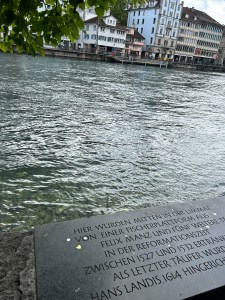
And so, five hundred years later, I found myself peering across a humble Zürich courtyard at the apartment where it all began. I also paused at a little plaque along the Limmat River that commemorated the site of the drowning of Felix Manz as punishment for breaking from church teaching on this matter. As I’ve written before, it was surprisingly moving to be where it all began. It also occurred to me for the first time how terribly young all these men were! Felix Manz was starting to ask uncomfortable questions of Zwingli and others at around 23 and was tossed in the river at age 29. Conrad Grebel was 27 when he baptized George Blaurock. George Blaurock was in his early thirties when the momentous events in that apartment took place. Menno Simons was a veritable fossil when he broke with the Roman Catholic church at the decrepit age of 40.
Even beyond the Anabaptist movement, it was often young men shaping the Reformation and its theology. Martin Luther was 33 when he nailed his theses to the Wittenberg Cathedral door. John Calvin was 26 when he published his Institutes. Ulrich Zwingli began preaching in Zurich at the age of 35. Now, life expectancy in the sixteenth century was not what it is now. And our time is uniquely plagued by delayed adolescence and the infantilization of culture more generally. But still. These guys were shaping history (for good and for ill) at a time when many young men in our time haven’t cracked a book in years (maybe never) and are lounging around playing Call of Duty in their parents’ basements.
It’s simultaneously impressive and a bit unsettling to ponder the role of young men in the Anabaptist movement. On the impressive front, these were obviously very serious, idealistic young men. The issues mattered deeply to them—they were literally life and (premature) death! But it’s also a tad unsettling to think of, well, how young these serious, idealistic men were. How unshakeably convinced they were that they were right. How obnoxious they could be in some of their disputations. How self-righteously and “holier-than-thou” they came across. How they seemed to demand perfection from the church—a “church without spot or blemish” (Eph 5:27). How they seemed to want to just tear it all down to the studs and start again with the pure and uncontaminated.
Over lunches and coffees in Zürich, a few of us commented on the similarities between the early Anabaptists and many of the (often young) activists that take to the streets to protest the various issues that inflame the secular imagination with religious zeal (Israel/Palestine, racial tensions and colonial legacies, gender/sexuality battles, climate change, etc.). The idealistic impulse is the same. Tear it down and start again with the pure and uncontaminated. Everything that came before us was oppressive and terrible and wrong! There is a righteous few who know the truth and who imagine themselves to be heroically dragging along the recalcitrant and immoral institutional defenders along with them toward progress. It’s just that simple!
Perhaps it’s just because I’m not a young man anymore. Perhaps it’s because I have always been disposed to seeing both sides of any issue and because, in my observation of the world, things are rarely (if ever) as black and white as the ostensibly pure and uncontaminated often frame things. Perhaps it’s because even a cursory glance at history seems to yield the conclusion that many good and necessary things are often sacrificed on the altar of a righteous zeal for purity (whether religious or secular). Perhaps it’s because I look in my own heart and mind and see all too many spots and blemishes. But my approach to the young idealists is increasingly more cautious. Be careful how much you’re eager to tear down, I often want to say. You may not be as right (or as righteous) as you think you are. You might have the odd thing to learn. Sometimes, wisdom comes with age.
I left Zürich very grateful for the witness of those first Anabaptists. Their courage in the face of opposition and pressures that I can scarcely imagine humbles and astounds me. I agree with many of their views even if I would hold some of them more loosely with the benefit of five hundred more years of history and (thanks be to God!) reconciliation taking place. It was inspiring and moving to be where it all began. But I also left with perhaps a bit more reticence to take as authoritative or timeless the words of the idealistic young men of the Anabaptist movement (or, indeed, the Reformation!). They of course didn’t get everything right. No person at any time or place, save Jesus Christ, has. To Manz, Grebel, Blaurock and all the others, I might want to say, “It’s a dangerous thing to imagine that you can create a pure church. This side of eternity, that does not, will not, and cannot exist.” Or, as a scholar friend recently put it in her excellent sermon reflecting on the events in Zürich:
We’ve never managed to be a church without spot or wrinkle. Dear God we have so many spots and wrinkles. Which is the same thing as to say that ours is a church that is in need of grace. But we have a fount of grace, thanks be to God, who calls us ever back, in a spirit of humility and repentance to Him.
——
I took the photo above while walking along the Limmat River in Zurich just under a month ago. It is the plaque mentioned above, the spot where Felix Manz was executed by drowning.
Discover more from Rumblings
Subscribe to get the latest posts sent to your email.


 Rumblings
Casares Garcia message in the grossmunster was amazing interpretation of the Elisha event
Yahoo Mail: Search, organise, conquer
This one resonates with me and is somewhat analogous to my own faith journey. Like these Reformation leaders I too came to a place where I could no longer be peacefully and faithfully reconciled to Christ, through the Catholic church.
The first thing I would say about my decision to leave Catholicism is that God may view some part of my decision, perhaps even all of it, as sinful. Based on pride, hurt feelings and inaccurately harsh judgement and not of His will and word for me. I didn’t know then and I don’t know now if this decision was/is the right one. I did know then that, sinfully or not, I was unable to orient myself peacefully and faithfully to God and the only thing I hadn’t tried was to leave the church. Subsequent to leaving and joining a Baptist fellowship my peace has returned and my faith has grown stronger. The first fruits have been good. So, sinful or not, God has graced me.
So maybe the point of it all is that, as long as we’re making an honest effort to worship Christ faithfully and live in accordance with Gospel principals then God will bless us with a true experience of His Holy Spirit, the spirit of truth and that blessing can be bestowed upon anyone irrespective of their denomination.
As for the the Spirit that animated some of the reformers, particularly Calvin, I claim unequivocally that their spirit was of the anti-christ and not of God. I think it just as true that the often murderous response to the Reformation by those who claimed to be of the one true church was equally despicable and demonic.
So to your point, yes I wholeheartedly agree. We can never be or even try to be, a church without spot or blemish. We can only be a humble people, honest in our faith, serving God’s will and one another, as a community of ever repenting sinners.
I wish you well in this new stage of your faith journey. I can imagine the decision you made was a painful and conflicted one (and remains so). I am convinced that God’s grace is greater than our sin, and that his blessing weaves through the choices we make, however conflicted or fraught they may be. I pray that you find this to be true in your life.