Mercy is the Way

When you walk the Camino, you hear the same phrase repeatedly. From locals, from fellow pilgrims, from whoever: Bom Caminho (in Portugal) or Buen Camino (in Spain). Literally, these both translate into English as “Good Way.” More colloquially and contextually it means something like “Have a good journey.” It was nice to hear these words and to speak them to others.
A question I have found myself thinking about a lot recently (before, during, and after the Camino) is a simple one: What does it mean to walk in a good way? What is the good way that we should seek to walk in? People walk the literal Camino in all kinds of ways and for all kinds of reasons. There are devout Roman Catholic pilgrims making their way to the bones of St. James, “spiritual but not religious” types, post-evangelicals, agnostics seeking a bit of outdoorsy adventure, and curious folks looking for Instagram content. There are cancer survivors and people grieving losses and couples trying to save a marriage and people walking on behalf of those who can’t. There are people carrying enormous burdens and those vibrating with excitement and optimism. There are many ways to walk and many different reasons for walking.
What about the way of life more broadly? What does it mean to walk in a good way? I spent portions of the Camino meditating on a single verse from the Beatitudes: “Blessed are the peacemakers, for they will be called the children of God.” What does it actually mean to be a peacemaker? I hate conflict and instinctively recoil from it in all its forms, but I’m pretty sure this isn’t what it means to be a peacemaker. I’m also reasonably convinced that it doesn’t mean lining up as a left-wing political activist or waving the pacifist flag with a bit of Jesusy justification. Whatever it means to make the kind of peace that Jesus blesses, it is more demanding than conflict avoidance and deeper and wider and truer than a political position.
And what does it mean to make peace in this particular time and place, where everything feels fraught, where so many seem so angry, where we wear all our differences as identity markers, where we instinctively perform our outrage and virtue, where politics is provocation, where so many conversations seem to have landmines around every corner. I don’t want to overstate things. The world has always been a fractured and chaotic place if only because the world has always been peopled by, well, people. Sinful, selfish, stupid people who barely understand themselves half the time and are fuelled by all kinds of unholy motives. But our media ecosystem puts all of this in front of us all the time. The algorithm rewards division and conflict. And so, we fall in line behind our digital overlords.
At the very least, it feels like we are in a time that desperately needs real peacemakers. And I want to be one who makes peace. More than anything, I want to be called a child of the God who desires peace. It seems to me that this should be among the central tasks of anyone who calls themself a Christian.
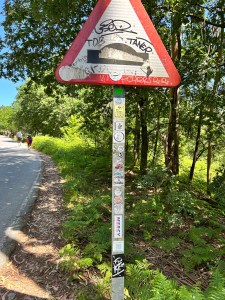 One of the things you see quite regularly on the Camino is stickers. Stickers plastered on walls, on markers, on traffic signs. Wherever. A few days in, I noticed one sticker on a traffic sign. Amidst all the chaos of slogans and advertising was a single word: Mercy. Now, for all I know “Mercy” could be the brand of some product that I’m unaware of. But I chose to interpret this sticker on a sign as, well, a sign. Mercy is what it means to walk in a good way. We cannot walk well without mercy—without extending it to others and without receiving it from them. There can be no lasting peace in our lives and in our world without mercy. This is precisely because we are sinful, selfish, stupid people who barely understand ourselves half the time. As Elizabeth Bruenig succinctly put it in her moving essay on interacting with death row inmates, “we are all convicted sinners.” Perfect people don’t need mercy. Real people do. All the time.
I suspect everyone who has kept company with Jesus for any length of time has a kind of “greatest hits” collection from the New Testament. Favourite verses, favourite interactions, favourite stories. I have many and I’ve written about a few often in this space. One is a few chapters after Jesus’ beautiful “blessed ares.” He’s eating at Matthew the tax collector’s house, sitting around the table with a bunch of unsavoury people. This displeases the Pharisees, a group of religious leaders who seem singularly untalented when it comes to mercy. They ask Jesus’ disciples why their teacher keeps such poor company. And Jesus famously responds with some of the most hopeful words in all of Scripture:
“It is not the healthy who need a doctor, but the sick. But go and learn what this means: ‘I desire mercy, not sacrifice.’ For I have not come to call the righteous, but sinners.”
He’s quoting from the prophet Hosea with that “I desire mercy, not sacrifice bit.” Just so the Pharisees would have a bit of homework to go and busy themselves with, so that they’d see he was echoing themes they should already be familiar with. But the “I have not come to call the righteous but sinners” part is all his. And thank God, because that’s all of us. Sinners who at our best still long for peace. Sinners who at our best and at our worst need to go and learn that God desires mercy and not sacrifice, that this is the way to walk.
——
The feature image above is taken from Elizabeth Bruenig’s beautiful essay in The Atlantic which I highly recommend reading.
Discover more from Rumblings
Subscribe to get the latest posts sent to your email.


 Rumblings
Lovely post, eloquent writing. Thank you. What is peacemaking? I think one form of peacemaking is abstaining from social media, as you do.
Chris
Leaving social media is a decision that I have rarely regretted and which comes to seem wiser with each passing year. One of the few downsides is that traffic on this blog has dipped, but I knew this would happen and it was a trade-off I was prepared to make.
Thanks, Chris.
I like the Jordan Peterson interpretation of peacemakers. Those who know how to use a sword but choose to keep it sheathed.