In the Name of Jesus
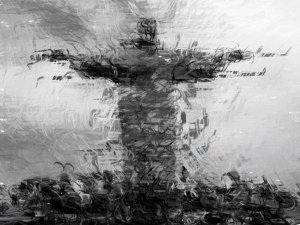
I had never heard of Charlie Kirk before yesterday. But his assassination is, of course, front page news everywhere today. Another disgusting tragedy, another spasm of violence in culture addicted to violence, another casualty of a toxic political culture and a diseased discursive climate, another outrage to dominate and be weaponized by social media before we collectively yawn and move on to the next outrage. It all feels so utterly wearisome and predictable and inevitable in our fractious, polarized, and distractible times.
I doubt I am alone in saying that I am exhausted by our cultural moment. The left and the right seem to be drifting ever further apart and the divide seems to be hardening. This is true, to our great shame, in the church as much as in the broader culture. Far too often, it is our politics not the way of Jesus that informs our identities and allegiances and gives our lives ultimate meaning. The church’s tendency to simply reproduce and feed off our tired and bankrupt politics has grieved me for some time now.
In my morning prayers this morning, I came across Colossians 3:17: “And whatever you do, whether in word or deed, do it all in the name of the Lord Jesus.” What would it actually mean for the church to seek for all of our words and deeds to be done in the name of the Lord Jesus? How would it change the way we engage with others (including those with whom we disagree)? How might it inform our priorities? Our responses to the latest outrage? Our impulses and desires? How might it shape our churches?
Out at the jail on Monday, we spent some time in the Beatitudes. This is, of course, the most Jesus-y of Jesus’ teaching, an encapsulation of what he was about, of the kingdom he was bringing, and the ethos that he would embody to his death. What would it look like if the churches that bear his name were more committed to his way than to their preferred visions of progressive or conservative, left or right, etc.? What if this was where we started when it came to seeking to do everything in the name of the Lord Jesus?
Blessed are the poor in spirit, for theirs is the kingdom of heaven… Whatever else “poor in spirit” might mean, it surely precludes the angry impulse toward the hot take, the take-down, the delicious high that comes from revealing how stupid and wicked the other side is. The poor in spirit surely, at the very least, know that they are sinners in need of grace. And not just as a theological maxim to affirm, but as a bone-deep self-awareness of our own sin and frailty.
Blessed are those who mourn, for they will be comforted… Not just a generalized lament at the state of affairs, not just a mourning for the victims, not just a “thoughts and prayers” kind of response that shows up whenever there is a fresh tragedy to comment on, but a mourning at our complicity in the way things are. A mourning of our own impulses and desires that feed a broken system, a mourning of the ways in which we love what we ought not to love and we don’t hate what we should.
Blessed are the meek, for they will inherit the earth… The meek don’t stand out. And could there be anything worse in the digital age and in our hyper-politicized moment than not standing out? The meek might get pushed around, misunderstood, overlooked. The meek don’t go viral and they don’t win culture wars.
Blessed are those who hunger and thirst for righteousness, for they will be filled… Do we still have the capacity to hunger for a righteousness that goes beyond ourselves? A righteousness that summons both left and right to higher standards and deeper truths. A righteousness that tears down some of our own preferred idols? A righteousness that demands repentance and conversion?
Blessed are the merciful, for they will receive mercy… Christ, how we need mercy here and now. Judgment and condemnation and mockery are the very oxygen of the internet and our collective discourse. Too often, mercy feels like a concession, a defeat. But it is not. Mercy is the better, harder way of Jesus. Mercy is what Jesus desires.
Blessed are the pure in heart, for they will see God… Purity is too often seen as naïve, puritanical, unenlightened, whatever. We’d rather defile our hearts with wickedness masquerading as realism, and permissiveness pretending to be sophistication.
Blessed are the peacemakers, for they will be called children of God… We claim to hate violence, but I wonder if we actually love it more than we want to admit. Our entertainment is saturated in it. The kinds of discourse that are incentivized in our media ecosystem depend upon it. We are simultaneously horrified by and engrossed in it. We perhaps even silently (or not so silently) cheer it on when it’s perpetrated by the good guys (i.e., our team). Peace isn’t profitable and it doesn’t generate clicks. Peacemakers are weak and kind of pathetic. We have little interest in this kind of blessing.
I left the last two beatitudes out—”Blessed are those who are persecuted for righteousness’ sake” and “Blessed are you when people utter evil against you falsely—not because they are unimportant but because these are the two that are probably the most eagerly weaponized in our time. Both the left and the right imagine that they are the ones being persecuted for righteousness’ sake, that they are the ones reviled for telling the plain truth, etc. I just didn’t see a way to bring those two into the conversation in a helpful way. Also, this post was getting longer than I intended.
Is the above cursory reflection on the beatitudes the sum total of what it would mean for the church to do everything in the name of Jesus? No. Would it be a decent start or a helpful default to occasionally return to. I would certainly hope so! At the very least, it might give evidence that we are seeking to tune our lives not to the dictates of the political left or the right but to Jesus, who is the way, the truth, and the life. At the very least, the church might occasionally embody something different, something better, something more hopeful than what we see all around us. And we might give (imperfect, to be sure) evidence that there is a name that is above all names, Jesus Christ, the One in whom we live, move, and have our being, the One who demands our allegiance and who sets us free.
Image source.
Discover more from Rumblings
Subscribe to get the latest posts sent to your email.


 Rumblings